- Peter the Rock

“Alright, here we go,” my brother said. He’d been describing the Catholic belief about the Papacy, and he was about to explain the Scriptural and Early Church evidence for these Catholic claims. Or, in my opinion, he was going to try to.
“Catholics believe that the earliest Christians understood Peter to be the leader of the apostles, and that Peter’s unique role was intentionally created by Christ,” Brendan began. “Something to remember is that if Jesus gave Peter a unique position of governance among the apostles, we should see its roots in Scripture, and it’s reality in church history and in the writings of the Early Church. We would expect Peter’s authority to appear as pre-eminent after Jesus ascends to the Father – not before, when Jesus was on earth and obviously in charge.”
He paused. “If it’s okay with you, I think I’ll begin with a few key passages Catholics claim support the Papacy. Then I’ll throw in quotes from the Church Fathers, and try to show that the Early Church believed the same thing the Catholic Church teaches today.”
“Bring it on,” I answered, tapping my pen on my notebook and flipping open my Bible.
“First, Matthew 16:13-18,” he began. “It says, “When Jesus came to the region of Caesarea Philippi, he asked his disciples, “Who do people say the Son of Man is?” They replied, “Some say John the Baptist; others say Elijah; and still others, Jeremiah or one of the prophets.” “But what about you?” he asked. “Who do you say I am?” Simon Peter answered, “You are the Messiah, the Son of the living God.” Jesus replied, “Blessed are you, Simon son of Jonah, for this was not revealed to you by flesh and blood, but by my Father in heaven. And I tell you that you are Peter, and on this rock I will build my church, and the gates of Hades will not overcome it.””
He paused, and then went on. “Now, Catholics believe that Christ identifies Peter as ‘the rock’ on which the Church is built, and that this gives Peter a unique position of leadership even among the apostles. Catholics believe Christ is saying that this Church, founded on the rock of Peter, will perpetually defeat the the gates of hell.”
“There are several common objections Protestants raise, when Catholics claim this passage is evidence for Peter being the first Pope,” Brendan continued. “To start, some Protestants believe that because there are different words being used – ‘Peter’ and ‘rock’ – Jesus must be referring to two different things.”
“Yes, I’ve heard that argument in church many times,” I said.
“For sure,” Brendan answered. “But an important thing to remember is that if Jesus spoke Aramaic – which is likely – then the words spoken for ‘Peter’ and ‘rock’ would be identical. Jesus would say here, in Aramaic, “you are kepha, and on this kepha I will build my church.” In fact, the consensus of Protestant scholarship – for a while now, actually – has been in agreement that Peter is the ‘rock’ to which Jesus refers. As one example, D.A. Carson – a super respected Protestant scholar – agrees with this concept in The Expositor’s Bible Commentary. Also, the Evangelical standard Greek Theological Dictionary of the New Testament, in a section authored by Lutheran scholar Oscar Cullman, states that the second rock can only be the same as the first rock. Even John Calvin said there isn’t a difference between petros and petra, in his commentary on Matthew, Mark, and Luke.”
“Wait, really?” I asked. That surprised me.
“Yes,” Brendan replied. “Another objection you may hear is that, in Greek, the words are translated as ‘petros’ and ‘petra’ for ‘Peter’ and ‘rock,’ and so therefore Peter must not be the ‘rock’ to which Jesus refers.”
“I’ve heard that one before as well,” I said.
“Sure. But the answer here is simple: Simon Peter is a man, so in Greek the ending of petra had to change to petros. Otherwise, readers would think Jesus is giving Peter a girl’s name. Which would be weird.”
“That makes sense,” I conceded, “but another thing I’ve heard is that the ‘rock’ in this verse is only referring to Peter’s confession of faith. Are Catholics saying Peter’s confession is somehow less important or something?”
“Not at all!” Brendan exclaimed. “Catholics believe that Peter’s confession is the bedrock of Peter’s authority – Jesus builds His Church on Peter because of Peter’s faith. Section 552 of the Catechism explains that, “Simon Peter holds the first place in the college of the Twelve; Jesus entrusted a unique mission to him. Through a revelation from the Father, Peter had confessed: “You are the Christ, the Son of the living God.” Our Lord then declared to him: “You are Peter, and on this rock I will build my Church, and the gates of Hades will not prevail against it.” Christ, the “living Stone”, thus assures his Church, built on Peter, of victory over the powers of death. Because of the faith he confessed Peter will remain the unshakable rock of the Church. His mission will be to keep this faith from every lapse and to strengthen his brothers in it.”
I was quiet, thinking this over. I dug my copy of The Catechism of the Catholic Church out of my bag and jotted down ‘552’ to look up later.
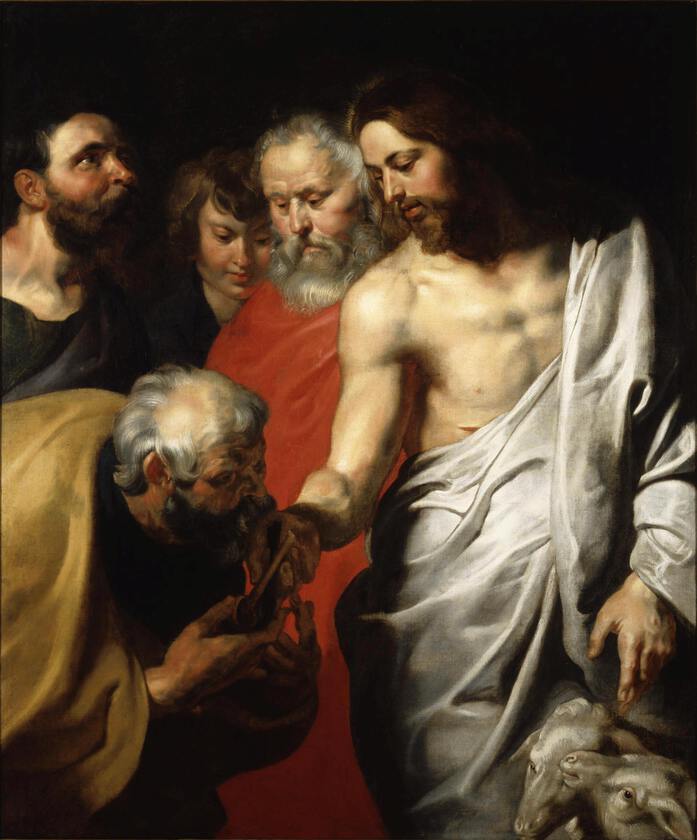
“The next section fleshes out the rest of the Catholic claim,” Brendan went on. “The Catechism says that “Jesus entrusted a specific authority to Peter: “I will give you the keys of the kingdom of heaven, and whatever you bind on earth shall be bound in heaven, and whatever you loose on earth shall be loosed in heaven.” The “power of the keys” designates authority to govern the house of God, which is the Church. Jesus, the Good Shepherd, confirmed this mandate after his Resurrection: “Feed my sheep.” The power to “bind and loose” connotes the authority to absolve sins, to pronounce doctrinal judgments, and to make disciplinary decisions in the Church. Jesus entrusted this authority to the Church through the ministry of the apostles and in particular through the ministry of Peter, the only one to whom he specifically entrusted the keys of the kingdom.””
- Keys, bind, loose
“The “keys,”” Brendan continued, “are so important, and I want to stick with that for a minute. In Matthew 16:18, Jesus is saying to Peter, “I will give you the keys of the kingdom of heaven; whatever you bind on earth will be bound in heaven, and whatever you loose on earth will be loosed in heaven.””
“The language used here is critical,” he said. “Every “you,” spoken by Jesus is singular. It isn’t “y’all.” It’s you. Jesus is still only talking to Peter, and He tells Peter that He is giving Peter the keys of the kingdom of heaven, and the power to bind and loose.”
“Is this related to the ‘steward’ idea you were talking about earlier?” I asked.
“Yes. Jesus is echoing Isaiah 22, which says, “in that day I will summon my servant, Eliakim son of Hilkiah. I will clothe him with your robe and fasten your sash around him and hand your authority over to him. He will be a father to those who live in Jerusalem and to the people of Judah. I will place on his shoulder the key to the house of David; what he opens no one can shut, and what he shuts no one can open. I will drive him like a peg into a firm place; he will become a seat of honor for the house of his father. All the glory of his family will hang on him: its offspring and offshoots—all its lesser vessels, from the bowls to all the jars.””
“Jesus, the new David, is establishing His new steward of His new kingdom,” Brendan continued. “That steward is Peter. This reference in Isaiah to ‘opening’ and ‘shutting’ mirrors the ‘binding’ and ‘loosing’ of Matthew.”
“What does ‘bind’ and ‘loose’ mean, again?” I asked.
“It’s a concept used by Jewish rabbis to mean one’s authority to make binding decisions on one’s people, as well as the authority to interpret and apply Scripture,” he replied. “The king’s steward was given the authority to interpret and apply the law in the king’s absence. Now here we are in Matthew 16, and Jesus is giving this same office to Peter. The keys, the binding and loosing – it’s the same concept as in Isaiah. The words used imply enormous meaning for Peter, for his role, and for the role of his successors.”
“But later in Matthew 18:18,” I interjected, looking down at my Bible, “Jesus is speaking to all the apostles when He repeats, “Truly I tell you, whatever you bind on earth will be bound in heaven, and whatever you loose on earth will be loosed in heaven.” Jesus is now using the plural form of “you.” Doesn’t this mean that Peter’s supposedly “singular” authority is actually shared with all the apostles?’
“Catholics agree that all the apostles are given the authority to bind and loose,” Brendan answered. “This is why our bishops today have authority to define doctrine in unity with the Pope, to exercise Church discipline, and so on. It’s because each bishop’s authority comes from his succession to the apostles. Jesus gave all the apostles this authority, but it originates with Peter. Over and again, Peter is set apart in a unique way, even within the group of apostles.”
Brendan waited for a minute, giving me time to process.
“Of course,” he continued,” this is not the only passage that supports the primacy of Peter, but it’s still a huge one. Why would Jesus give Peter a new name, proclaim him the foundation of the Church that Jesus is building, give only Peter the keys to the kingdom, and first give Peter the authority to bind and loose – if Peter is meant to be just a normal disciple who is the same as other apostles, with no special role and no office that is meant to be passed down? Why would Jesus specifically refer to Eliakim – the steward and second in command of the king, who answered to the king only, and whose office was passed down – if Jesus didn’t intend for Peter to take on and pass down Eliakim’s role of “opening” and “shutting,” or “binding” and “loosening?””
- More Scripture
“The connection is fascinating,” I said, slowly. I didn’t know what to think about all of this. “I’ll look into this later – are there any other places in Scripture that supposedly support the Catholic claim to the Papacy?”
“Yes,” Brendan replied, “I’d love to talk about a few more passages, if that’s okay: Luke 22:24-32, John 21:1-14, and John 21:15-19.”
I jotted these verses down and opened my Bible to Luke.
“In Luke 22, Jesus tells the apostles that the greatest among them will be their servant – and then Jesus gives Peter the singular role of serving the apostles, as the apostles serve the Church. Yes, all of the apostles are called to servant leadership, but Peter is told to be their servants. He is the first one called to be the “servant of the servants of God.” Catholics believe that the apostles are the twelve foundation stones of the Church, but that Jesus prays specifically (verse 32) for Peter’s faithfulness and strength in strengthening his brothers, as their leader. Once again, Jesus is singling out Peter: Jesus prays for Peter only and gives him the unique job of strengthening the other apostles.”
I heard papers rustling as Brendan flipped to the next verse.
“Next, in John 21:1-14, Simon Peter single-handedly hauls ashore the miraculous catch of 153 large fish that the other apostles together could not even haul aboard the boat. Catholics believe the supernatural strength given to Peter is enormously symbolic: Peter is able to bring ashore all the fish in the net to Jesus, without losing one fish or tearing the net. The sea represents the world, the boat represents the Church, the fish represent those who enter the Church, and the net represents the unity of the Church – and its ability to hold an unlimited number of people. Catholics believe that Peter, the ‘fisher of men,’ brings the net to Christ – both in this passage, and till the end of time. In fact, St. Jerome later explained that the number ‘153’ was the number of known species of fish at that time. The fish therefore indicate that the apostles will ultimately haul in believers from every nation: Peter will carry the net to Christ, and the net will never break.”
“Hey, want to know a fun fact?” Brendan asked suddenly, breaking me from my reverie of imagining the scene from John 21.
“Aren’t these all fun facts?” I asked, dryly.
“Well, yes,” he laughed in reply, “but I thought this was extra cool. I think I heard this in a ‘Deep in History’ lecture or something. After Jesus, who do you think was the person most represented in early Christian art?”
I thought for a moment. “I have no idea.”
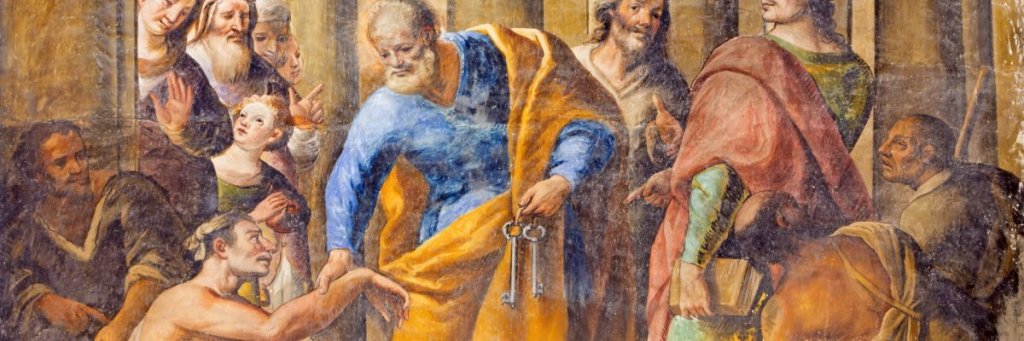
“Peter,” he said. “Peter holding keys, Peter on a boat, or Peter on the chair of Moses. I found that amazing.”
“That is interesting,” I said. “It makes me want to know more about what the Early Church said about Peter.”
“One more verse and we’ll get to that,” Brendan replied. “To recap so far, Peter is called to be the greatest when he is commissioned as the servant of all the servants of God in Luke 22; Peter hauls the great net of fish to Jesus in John 21, which the other apostles can’t even budge; and finally, John 21: 15-19: Jesus the Good Shepherd calls Peter to be the shepherd of Jesus’s sheep, in a very unique way.”
I flipped to the correct page in my Bible as my brother began.
“Jesus, the eternal Chief Shepherd and the one ‘Good Shepherd,’ now makes Peter the ‘shepherd after God’s own heart.’ By commanding Peter to “feed my lambs,” “tend my sheep,” and “feed my sheep,” Jesus is calling Peter to be the shepherd of Jesus’s sheep. The care of Christ’s flock is now entrusted to Peter. Peter, who had denied Christ three times while warming himself by a fire, now affirms his love for Jesus three times around the fire described here in John. Jesus asks Peter if Peter loves Jesus “more than these,” and then instates Peter in his unique role: as the shepherd of Jesus’s sheep.”
- The Primacy of Peter in the Early Church
My mind reeled with new categories I’d never considered before – categories my brother claimed were completely supported by Scripture: Peter as chief servant, Peter as the chief fisher of men, and Peter as the unique shepherd of Christ’s sheep. Whether or not the Catholic position would ultimately prove to be the correct one, the information laid before me so far was fascinating – not to mention compelling.
“I know I’m skimming over these verses,” Brendan was saying, “and there are a lot more passages I could cover: Matthew 17:24-27, Matthew 14:23-27, Peter’s role throughout Acts – especially Acts 5:15! – or how every time the apostles are listed or alluded to, Peter is either the only name given – as in, “Peter and the other apostles” – or he is listed first – every single time.”
“I’ll look into those on my own,” I said, writing the passages down, “talk to me about the Early Church’s claims about Peter.”
“Alright,” Brendan replied. “But just a thought, if you ever become Catholic and decide to write a blog detailing your conversion, definitely don’t just cram endless Scripture passages and Church Father quotes into one post. That would be exhausting for people reading it.”
“Obviously,” I answered. “I would never do that.”
- Tertullian, Cyprian, Ephram, Ignatius, Opatus, Ambrose
“Okay,” he went on, “so in summary, Catholics believe that Peter is the ‘rock’ of the Church, and that his primacy extends to his successors. I’ll try and show that this belief is also all over the writings of the Early Church.”
He thought for a moment. “I think asking the question, ‘how did the first Christians interpret these verses of Scripture?’ is super important for understanding our faith. It comes back to the question of authority, once again. Maybe a Protestant pastor interprets these verses differently – but on what authority? The Early Church had the voices of the apostles still living in their memories. I think we need to take their understanding of these passages seriously.”
I heard papers rustling* in the background once more.
“I’ll give a few examples,” he began. “Tertullian wrote in 200 A.D., ““Was anything withheld from the knowledge of Peter, who is called ‘the rock on which the Church would be built’ [Matt. 16:18] with the power of ‘loosing and binding in heaven and on earth’ [Matt. 16:19]?””
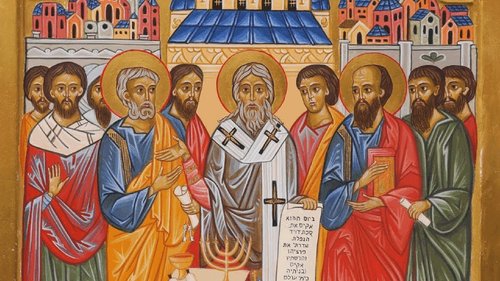
“Next,” he went on, “in 251 A.D., Cyprian of Carthage wrote, ““The Lord says to Peter: ‘I say to you,’ he says, ‘that you are Peter, and upon this rock I will build my Church, and the gates of hell will not overcome it. And to you I will give the keys of the kingdom of heaven . . . ’ [Matt. 16:18–19]. On him [Peter] he builds the Church, and to him he gives the command to feed the sheep [John 21:17], and although he assigns a like power to all the apostles, yet he founded a single chair [cathedra], and he established by his own authority a source and an intrinsic reason for that unity. Indeed, the others were that also which Peter was [i.e., apostles], but a primacy is given to Peter, whereby it is made clear that there is but one Church and one chair. . . . If someone does not hold fast to this unity of Peter, can he imagine that he still holds the faith? If he [should] desert the chair of Peter upon whom the Church was built, can he still be confident that he is in the Church?””
“Cyprian doesn’t mess around, huh?” I said, feeling rather bowled over by Cyprian’s words.
“I mean, no. Peter is called the “source” and “reason” for unity, for good reason.”
“But Cyprian is saying that a person is only in the Church if they “hold fast” to the unity of Peter. That’s intense.”
“It is. Let’s go through a few more.”
More papers rustled, and he continued.
“In 351 A.D., Ephram the Syrian wrote, ““[Jesus said:] ‘Simon, my follower, I have made you the foundation of the holy Church. I betimes called you Peter, because you will support all its buildings. You are the inspector of those who will build on earth a Church for me. If they should wish to build what is false, you, the foundation, will condemn them. You are the head of the fountain from which my teaching flows; you are the chief of my disciples’” (Homilies 4:1).””
“Primacy, chief, head,” I said, taking notes, “any references to “rambo” or “sir president?” I asked, sarcastically.
“Actually, yes!” Brendan said, laughing. “I almost forgot my favorite quote! This is the earliest one yet, from 110 A.D. “Ignatius . . . to the church also which holds the presidency, in the location of the country of the Romans, worthy of God, worthy of honor, worthy of blessing, worthy of praise, worthy of success, worthy of sanctification, and, because you hold the presidency in love, named after Christ and named after the Father (Letter to the Romans 1:1, emphasis added).” So, yes, the Roman church held the “presidency” over all the other churches.”
I tapped my pencil nervously.
“Hang with me,” Brendan said, laughing. “I have two more!”
“Yikes,” I said. “Let’s finish it out.”
“I will, and I’ll send you links to all the primary texts so you can read everything in context. There are so many more examples! Optatus, in 367 A.D., said, “You cannot deny that you are aware that in the city of Rome the episcopal chair was given first to Peter; the chair in which Peter sat, the same who was head—that is why he is also called Cephas [‘Rock’]—of all the apostles; the one chair in which unity is maintained by all (The Schism of the Donatists 2:2).””
“Finally, Ambrose of Milan – who helped convert Augustine, wrote in 389 A.D., “It is to Peter that he says: ‘You are Peter, and upon this rock I will build my Church’ [Matt. 16:18]. Where Peter is, there is the Church. And where the Church is, no death is there, but life eternal (Commentary on Twelve Psalms of David 40:30).””
“In summary,” Brendan concluded, “Catholics believe what the Early Church believed. The Church is not only a mystical body of believers. It has apostolic succession, it is visible, it is united under the Pope; it is something you can point to, and be part of.”
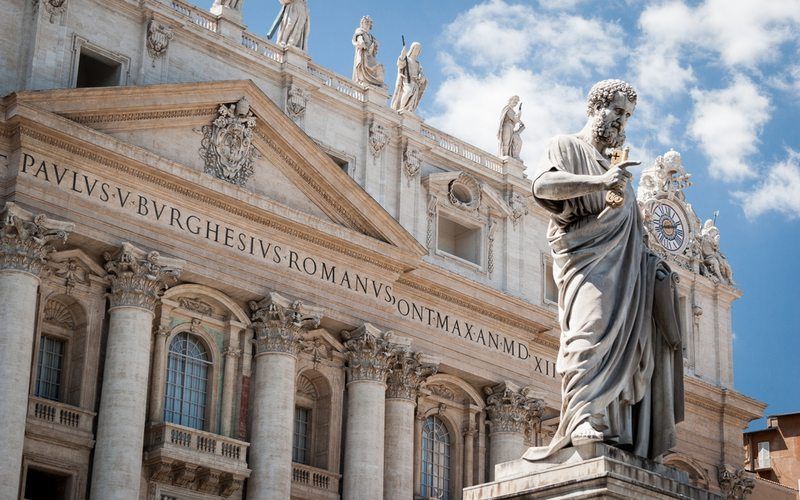
- Mystical and Visible
I thought for a moment.
“Look, in one sense, I am on board with the need for apostolic succession, but my Protestant brain still argues that the ‘church’ is simply the invisible body of believers. If you believe in Christ, then you’re in the family of God – period.”
“Oh, definitely,” Brendan answered. “The Catechism teaches the same thing – that there is unity in the “Mystical Body” of all believers. It cites Galatians 3:27-28: “For as many of you as were baptized into Christ have put on Christ. There is neither Jew nor Greek, there is neither slave nor free, there is neither male nor female; for you are all one in Christ Jesus.””
“Claiming to be the original Church isn’t a claim that there are no Christians outside of it, nor that all Catholics are necessarily going to heaven,” Brendan said. “Only God knows that. But, Catholics do believe that the Church is, as the Catechism says, “both visible and spiritual, a hierarchical society and the Mystical Body of Christ. She is one, yet formed of two components, human and divine. That is her mystery, which only faith can accept. The Church in this world is the sacrament of salvation, the sign and the instrument of the communion of God and men.”
We both sat in silence for a while.
“Look,” Brendan said, “I’ve barely scratched the surface, and I’m sure you will want to look into whether the Protestant response to this is legitimate. Here is my final thought, for now. Like I said at the beginning, if Jesus established Peter in a unique, successional leadership role, we would see its roots in Scripture and it’s reality in the Church Fathers and in early church history. And, we do. It’s all there.”
- Only the beginning
My brain was swirling. I didn’t know what to think, but I knew I felt overwhelmed.
Suddenly, my phone started buzzing.
“Hey, mom is calling,” I said. “I’ll let you go for now, but let’s talk soon.”
“Sounds good!” He replied, “I love you, tell mom hi for me.”
We hung up, and I switched to my mom’s call.
I caught my mom up on my conversation with Brendan, and explained my remaining questions and hang-ups with Catholicism.
“Sounds like an interesting chat,” my mom said. “Dad and I have been having a lot of conversations with Brendan lately, and Beatrice too.” My parents had been reading and researching the topic of Catholicism for months. Every holiday and family reunion had become a lively Catholic-Protestant debate. We were all getting better at having pointed – yet charitable – theological conversations. My parents, who had been Catholic but became passionate non-Catholic Christians about fifteen years prior, were originally very concerned when Beatrice and Brendan began talking about their interests in Catholicism. However, over time, as they began to do their own reading and research, my parents were clearly becoming enthralled with their findings about what the Catholic Church actually believed, and why. They were stunned by all they hadn’t known before, when they were Catholic, and for many months they’d been reading books and discussing the topic non-stop.
Suddenly on the phone, my mom sounded serious.
“Sweetie, dad and I have been wanting to talk to you and Ryan.”
She paused.
“We’re ready to become Catholic.”
Resources
Primary Texts:
Peter’s Successors — Church Fathers
Peter’s Primacy — Church Fathers
Authority of the Pope — Church Fathers
Origins of Peter as Pope — Church Fathers
CHURCH FATHERS: Letter to the Corinthians (Clement)
CHURCH FATHERS: Epistle to the Smyrnaeans (St. Ignatius)
Media:
Why The Papacy Is Biblical w/ Suan Sonna
083: What You Need to Know About the Pope (w/ Joe Heschmeyer)
057: Unpacking the Biblical Roots of the Papacy (w/ Steve Ray)
Does Church History Lead to Catholicism? (Joe Heschmeyer & Dr. Gavin Ortlund)
Catholic/Protestant Debate: Is the Papacy Affirmed in the New Testament?
Answering Top Objections to the Papacy (w/ Suan Sonna)
Book:
Pope Peter, Joe Heschmeyer
Short tracts:
A Simple Case for the Papacy – Shameless Popery
How to Argue for Papal Infallibility
https://www.catholic.com/encyclopedia/pope
https://www.catholic.com/encyclopedia/infallibility
https://www.catholic.com/magazine/print-edition/defending-the-papacy
https://www.catholic.com/magazine/print-edition/authority-to-teach
https://www.catholic.com/tract/papal-infallibility
https://www.catholic.com/tract/origins-of-peter-as-pope
https://www.catholic.com/tract/peter-and-the-papacy
https://www.catholic.com/tract/was-peter-in-rome
https://www.catholic.com/tract/peter-the-rock
https://www.catholic.com/tract/the-authority-of-the-pope-part-i
https://www.catholic.com/magazine/online-edition/yes-peter-is-the-rock
https://www.catholic.com/magazine/print-edition/simon-the-petros
https://www.catholic.com/magazine/print-edition/defending-the-papacy
https://www.catholic.com/magazine/online-edition/the-papacy-in-scripture-no-rocks-required
https://www.catholic.com/magazine/print-edition/papal-authority-at-the-earliest-councils
https://www.catholic.com/audio/caf/what-popes-are-not
http://shamelesspopery.com/pope-peter-part-i-strengthen-thy-brethren/
http://shamelesspopery.com/pope-peter-part-ii-the-good-shepherd-calls-a-shepherd/
http://shamelesspopery.com/pope-peter-part-iii-jesus-tethers-peter-to-himself/
http://shamelesspopery.com/pope-peter-part-iv-peter-and-the-eleven/
*a moment of silence for the white binder full of writings of the Church Fathers that Brendan carried around for years.
 All the Gifts