
- Which Church?
Many years ago, a young woman – we’ll call her Beatrice – left home for college. A happy participant of a thriving Evangelical Free church, Beatrice expected to find something similar in her new college town. But as she settled in at school and began investigating local churches, she eventually came to a very uncomfortable conclusion: she had no idea how to choose where to go.
“I don’t get it,” I told her, as we were catching up on the phone one day. “Why is it so hard to pick a church?”
“I guess I just don’t know how,” she replied. “I’m supposed to pick a church based on… what?”
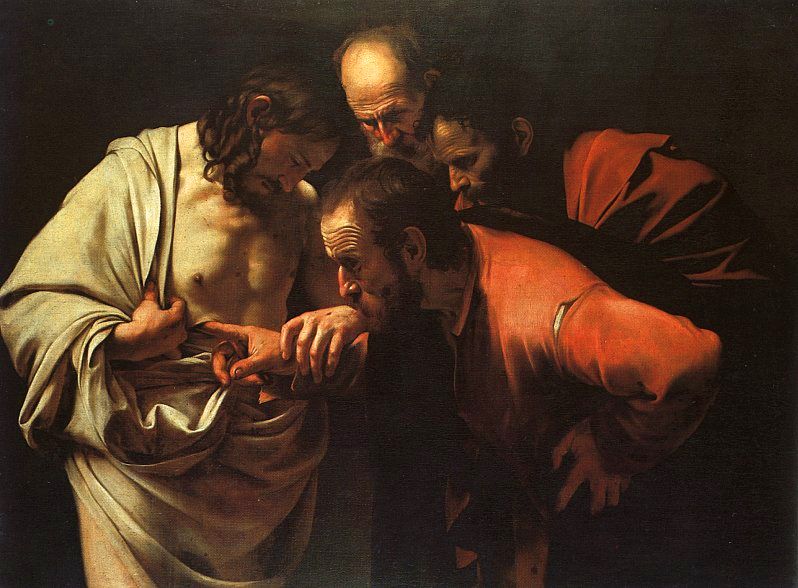
There were Methodist, Lutheran, Baptist and Non-Denominational options nearby, as well as Pentecostal, Evangelical-Free, and Presbyterian. As Beatrice began researching different denominations, reading various statements of belief, and visiting many churches, she found something rather troubling: choosing one church over another would mean professing agreement with answers to questions she’d never even asked before.
Such as:
Should infants be baptized, or only those personally capable of making a profession of faith? How does Baptism relate to our understanding of salvation? Is Scripture inerrant, infallible, both, or merely useful? Is love a necessary part of our justification or is it merely a sign of genuine faith? What kind of leadership roles should women have in the Church? How should a community of believers be governed? Is God’s grace resistible? What is the purpose of sacraments and how many are there?
Or:
Can a person lose their salvation after coming to faith in Jesus? Is there an immutable, predestined ‘elect’ for whom Jesus died, or did he die for all of humanity? How should we think of Christ’s second coming and the millennial reign? Should Creeds be professed, or does this somehow detract from the supremacy of Scripture? How should the Bible be read: as literally as possible, morally, typologically, through the lens of the oppressed, or some combination of these?
Over the ensuing months, Beatrice began to realize that no matter how many reasonable answers she found to her questions, one question always remained: “how do they know they are right?”
“Does it matter?” I asked her, after she brought this to my attention. “The important thing is that you go somewhere. Just pick a church and commit to it.”
“But, based on what?” She asked me, again. “Based on whether I like the type of music? Or if the pastor is especially engaging?” She sighed, feelingly, and looked directly at me. “I would never not go to church, but I don’t want to pick a church based on what I like! I want to pick a church based on truth. And how on earth do I know who knows the truth?”
“This is crazy,” I said, impatiently. “All these people at all these churches just love Jesus and want to help you follow Him. Harping on all these details is just detracting from the message of Christ. The rest is minor! All that matters is the Gospel.”
She simply stared at me.
“Then why are there so many different kinds of churches?”
“Because…” I replied, “They – some of them? – disagree over some minor issues. Which is fine.”
“Minor issues? Who decides which issues are minor?” She shot back. I still didn’t understand what she was getting all riled up about.
“Look, all these churches maintain real, objective differences over what is true, and over how we should practice Christianity,” she said. “Otherwise they wouldn’t have split in the first place. If one denomination is right, then aren’t the other denominations missing out on truth?”
“… maybe?” I replied. “But they also all agree about the most important part: Jesus is the Son of God, sent to earth to die for our sins, and He calls us to place our trust in Him. If churches disagree about other things, who cares?”
“Don’t you believe in objective truth?”
I wavered, feeling like I was being backed into a corner. “…Yes.”
“Then, I just think all of these issues should matter. Do you know what I mean?” She paused. “I mean, should we bring our babies to be baptized, or definitely wait until they can decide for themselves? Does grace ‘cover over’ our sin, or does grace erase sin and inwardly transform us by being infused into our souls? Can we lose our salvation or are we ‘eternally secure’ once we trust in Jesus? If we trust Jesus on some level, but have not made Him Lord over our lives, does this count as saving faith? Are charismatic gifts of the Spirit, like speaking in tongues, appropriate for worship today or did those gifts cease?”
She paused, thinking hard. “I think the answers to these questions not only matter for our spiritual lives, but should be of utmost importance. They impact literally every corner of our relationship with Jesus. Choosing one belief instead of another can lead to embracing bad theology, and false doctrine – how could that be unimportant? Where there are objective differences about faith, we should care about the answer!”
“But what matters the most is that we have a relationship with Jesus,” I replied, staunchly. “It sounds like you think there is some kind of hierarchy of churches that are “better” than others or “more true” than others. These churches all just teach the Bible! And Jesus! That’s what matters.”
“I would never think some people are “better” than others based on what church they go to,” Beatrice replied. “Of course not. But if there is a way to know what is true, than wouldn’t you want to know it?”
I could see the hunger, pain, and frustration in her eyes, which surprised me. I’d never thought of any of this before.
“I would never consider myself or any group of people “better” than any other,” she continued quietly. “I just want to know the truth. I just want to know Jesus as much as I can.”
She paused again, then went on.
“I’ve been trying to find a church for months, and what I’m learning is this: churches don’t “just teach the Bible.”” She sighed, rubbing her eyes. “Each church interprets the Bible according to its own tradition. It’s ‘the Bible as-interpreted-by Luther,’ or ‘the Bible as-interpreted-by Wesley,’ or ‘the Bible as-interpreted-by Calvin, or Knox, or Smyth, or Stone.’ What I want to know is who is right. Should Knox have split from Calvin, who split from Zwingli, who split from Luther? Whose tradition is right, and how can I know?”
- Whose Tradition?
I didn’t have an answer. I’d always thought that all I needed to grow as a Christian was to read the Bible and learn what it said. I’d never considered that different Christian denominations teach contradicting things about topics that – if I was being honest with myself – really did matter.
But I didn’t want to think about it, so I pushed the question aside for many years, all the way through college and into early adulthood.
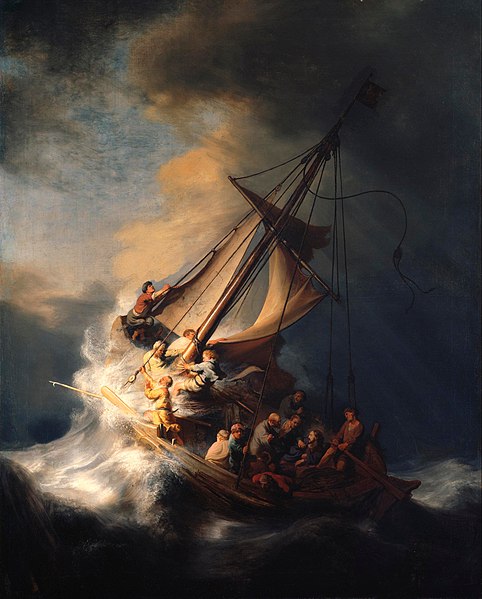
Then one day in church, many years later, my world changed. Our pastor preached a message emphasizing the uniqueness of “our” beliefs, over and against the doctrines of other churches. I loved this pastor, and his heart for God was unequivocally known and admired by all who knew him. But that day, I felt uncertain about the claims he was making. How could he be so sure that his interpretation of the Bible was the right one?
I never doubted my pastor’s faith, zeal, or intellect. But I knew there were other pastors right down the road, with the same credentials, the same study tools, and the same heart for God, arguing opposite conclusions.
“How does he know?” I wondered. “He is clearly trying to be faithful to the Bible, but so are the people he disagrees with. Would I believe something else about these major, soul-impacting doctrinal differences, if we happened to go to a different church?”
I felt lost, as if a sea of fog was rolling toward me, and I was powerless to stop it. The questions Beatrice had posed all those years ago suddenly came storming back into my mind. In an instant, I understood how she felt.
I closed my eyes, picturing the hundreds of churches in my small town. Even just on the route to our church, we passed by more than 5 different denominations.
“Why do there have to be so many different and divided communities of faith?” I suddenly found myself wondering. “Why isn’t there clarity on doctrine across all Christianity? Why is there so much disagreement and confusion, when virtually every pastor wants to love and serve Christ as faithfully as possible? And who am I to step in and say that I have settled all the differences between countless, well-meaning pastors from the thousands of different denominations? How am I supposed to be the final arbiter of what is true? How could these issues, which matter enough to divide Christians from one another, not matter to me too?”
After ignoring Beatrice’s questions for so many years, suddenly, I could think of nothing else.
I stood up with the rest of the congregation during the closing worship set, feeling like a completely different person than when I’d sat down for the sermon. I pondered this new question in prayer.
All I wanted in life was to know Jesus. All I wanted was the truth. But given the modern-day division among churches, how was anyone supposed to ever know the truth of how we should practice our faith? I pictured once more the dozens – the hundreds? – of different churches in my town.
“Why would Jesus command us to be “one” without giving us a means of remaining “one”?” I wondered to myself. “Was this the plan? Did Jesus intend for His church to descend into all these divisions – the thousands of denominations – that we have today? Wasn’t there another way?”
“Why would Jesus pray so passionately that we be “one,” as united as Jesus is with His Father, without giving us a way of achieving it?”
I reviewed Jesus’ words from John 17 in my mind: “And now I am no longer in the world, but they are in the world, and I am coming to you. Holy Father, protect them in your name that you have given me, so that they may be one, as we are one.”
Unity, I knew, kept coming up among these earliest Christians. Paul writes in Philippians 2:1-2, “if then there is any encouragement in Christ, any consolation from love, any sharing in the Spirit, any compassion and sympathy, make my joy complete: be of the same mind, having the same love, being in full accord and of one mind.”
Paul also writes to the Corinthians, “now I appeal to you, brothers and sisters, by the name of our Lord Jesus Christ, that all of you be in agreement and that there be no divisions among you, but that you be united in the same mind and the same purpose (1 Corinthians 1:10).”
Again, Paul asks us to be united, “making every effort to maintain the unity of the Spirit in the bond of peace. There is one body and one Spirit, just as you were called to the one hope of your calling, one Lord, one faith, one baptism (Ephesians 4:3-4).”
Leaving church that day, I began to question. I didn’t question the authenticity of the faith of the people around me – they were amazing, they loved us like family, and they loved Christ and wanted to follow Him with their whole lives. But I began to question our hermeneutic – the system, the method by which we approached the Bible and interpreted it.
For years I’d believed the doctrine of “Sola Scriptura” – the view that “the Bible alone” is the only infallible rule of faith for Christians. But if it’s true that we only need the Bible to know the truth, then why does everyone claim it says completely contradictory things? How on earth should Christians respond when different pastors use different passages of the Bible to support their differing conclusions? Does every Christian need to go to seminary, learn ancient Hebrew and Koine Greek, learn the historical context of every Scriptural argument, study every denomination’s commentary, become a trained philosopher, and sift through hundreds of hours of debate – just to determine which denomination lines up with what they think is right?
Is there a better way to arrive at the truth? Or is this a burden God simply intended each of us to bear?
I pondered some more. It truly felt like a burden. A crushing one, at that.
Furthermore, if unity is indeed the goal, can Sola Scriptura even get us there?
The Bible is the living, inspired Word of God. But how can we know what it means, when it comes to divisive issues? A book cannot interpret itself. Like the U.S. Constitution, like the Magna Carta, like even the most carefully crafted contracts and legal documents, the Bible can be interpreted in any number of ways.
If God intended – and commanded – us to be ‘one,’ then how can relativism on matters of belief ever be an acceptable option?
- Beginning the Search
I decided to bring my new angst to the wonderful youth pastor of our church. He had studied theology in college, and earned his Master’s of Divinity from a highly respected seminary which prides itself on teaching the whole spectrum of sides that divide Christians. He loved Jesus with all his heart, studied the Bible regularly, and was the smartest person I knew.
He also happened to be my husband.
I laid out all my questions to him on our drive home from church that day.
“I definitely agree that we have to do our best to teach the truth and to practice the faith according to what’s been laid out in the Bible,” he said. “There’s just a lot that God hasn’t made clear in Scripture. I’ve read a couple of books that go topic by topic through some of the key issues which divide Christian denominations, and I can see where each side is coming from.”
I nodded, waiting for him to continue.
“I just think after all is said and done, God hasn’t given us super specific instructions for how to practice the faith, and that’s okay,” he continued. “It’s our job as Christians to love one another and to focus on the things that unite us, instead of the things that divide us. I agree with the slogan, “we should have unity on the essentials and allow diversity on the non-essentials.””
This seemed reasonable. But as we continued driving, my prior questions continued to surface.
“How do we know what is “essential” and what is “non-essential?” I wondered to myself. “And who decides?”
I watched the houses flash by, and realized that a pit had settled somewhere in the region of my stomach ever since leaving church that day. It wasn’t budging.
I needed to learn more about this. After all, divisions and confusion probably existed in the earliest days of Christianity, after Jesus ascended into heaven and the disciples and their descendants were left to pass on the faith. How were divisive issues handled in the days of the early church? Who answered the important questions on faith?
I decided to find out.
 All the Gifts
good content…keep up the work
LikeLiked by 1 person
This is wonderful Margaret I have a precious Protestant sister friend, and her responses to me sharing my faith are exactly your responses to Beatrice. Oh how I pray she will follow this. God bless you for sharing your journey Home to the Catholic Church. . I cannot wait to journey with you and others following this,. So much to learn..
LikeLiked by 1 person
Thank you for these posts. My sister, Jessica, told me about this blog and it’s been helpful to follow. I’ve wrestled with several of these questions myself as well as doubts stemming from them in the past. I allowed myself to stay in a spiritual limbo because of them and other things for years. I’m looking forward to what subsequent entries reveal about understandings you’ve come to on your journey in Christ. Thank you.
LikeLike