I sat at the kitchen table, drumming my fingers and glaring at my computer screen. For the tenth time in as many minutes, I sighed in frustration.
Unsettled by the problem of doctrinal disagreement (or else relativism) among modern-day Christians, and wanting to understand why I should trust the authority of any denomination over another, one question had loomed large in my mind: how were divisions and confusion regarding doctrine handled in the earliest days of Christianity?
I was tired of being rattled by these enormous questions, so I had jumped into researching like the ecclesial equivalent of Jason Bourne, ready to crack the case and return to normalcy – ideally, in the length of time it takes to actually watch a Jason Bourne movie.
But instead, over the course of many days, all I found were more questions.
I stopped drumming the table and closed my eyes, reviewing the journey thus far.
- Questions

I had begun researching the early church under the assumption that those first Christians – like many Christians today – believed that the Bible was their sole infallible rule of faith.
However, as I pondered the fact that the New Testament was written over the first and second century, A.D., I began to wonder: how did these earliest Christians know and pass on the faith, before the Bible was completed?
As I started to research when and how the books of the Bible were compiled, I was surprised to learn that the official ‘canon’ of the Bible – the complete list of which writings were considered authentic and inspired by God – was not fully-defined until the late fourth century (at the Council of Rome, 382 A.D.). During this time, other hugely popular writings were also being copied, translated, circulated, and read at church gatherings – such as the writings of Ignatius, Clement, The Didache, and the Shepherd of Hermas – that were not ultimately included in the Bible.
Who had the authority to decide what to keep and what to leave out? If there is no doctrinal certainty outside of the Bible, how could those at the Council of Rome be sure they were making the correct decision?
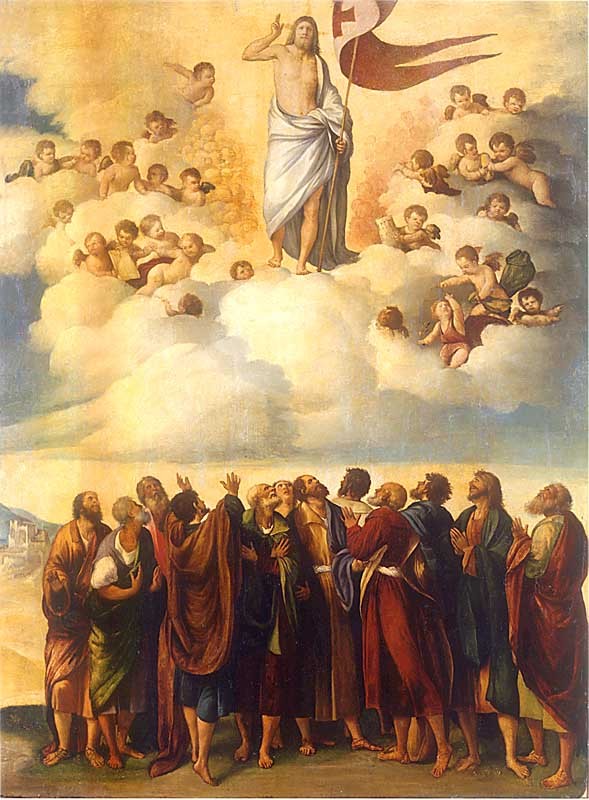
For the first time I began to consider the fact that after Jesus ascended into heaven, important doctrinal questions still needed to be answered – questions that the Bible didn’t necessarily clarify.
Determining the canon of Scripture is one example of something not clearly defined in Scripture, but many other crucial theological concepts were also disputed – such as the two natures of Christ, and the relationship between the three Persons of the Holy Trinity.
This brought me back to my original question: if the Bible is supposed to be our sole infallible rule of faith, how can theological questions be resolved if the matter isn’t clearly answered in the Bible?
If an interpretation of Scripture was required to resolve a dispute and define doctrine, who had the authority to make it? From where did their authority come?
I’d never thought about this before. I guess I’d always assumed that the NIV Bible – and perhaps an accompanying FAQ page – had just dropped out of the sky after Jesus rose from the dead.
I decided to learn about some of the early church disputes, and what the Church Fathers had to say about how they should be resolved.
- Heresy
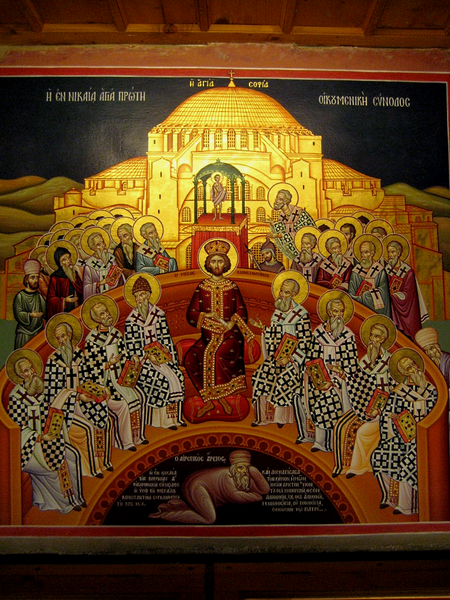
What I found was that, beginning with the earliest days of Christianity, a continuous stream of heresies (false teachings) arose. These heresies gravely threatened the purity and truth of the Christian faith, often amassing large followings of believers before finally being defeated.
Prominent false teachers included Judaizers (you must be circumcised and follow other Jewish customs to be saved – Acts), Gnostics (man is saved through personal spiritual enlightenment; the physical world is bad, so Jesus must have only looked like a man – 1st and 2nd centuries), Arians (Jesus is not co-eternal with God – 4th century), and Pelagians (we can become righteous by our own efforts – 5th century).
These heresies – of twelve or thirteen “great” heresies, which cropped up over time – caused major waves among believers, each gaining sizable patronage at different points in history. But they were all eventually and summarily rejected and labeled as false teachings by a group of people who claimed to know the truth.
How?

Clearly, confusion and division was common throughout church history.
How did the early church decide what was true and what was false?
- The Testimony of the Early Church: Irenaeus
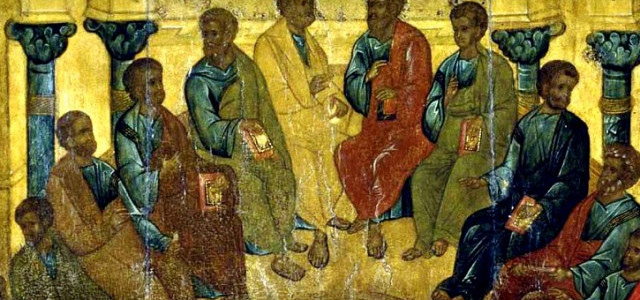
I was ready to dive deep into church history.
I began by searching, “church fathers defense against heresy,” and promptly found ‘Against Heresies’ by Irenaeus, writing in 189 A.D.
He had a lot to say.
“Suppose there arise a dispute relative to some important question among us, should we not have recourse to the most ancient churches with which the apostles held constant conversation, and learn from them what is certain and clear in regard to the present question?” (ibid., 3:4:1).
“The true knowledge is the doctrine of the apostles, and the ancient organization of the Church throughout the whole world, and the manifestation of the body of Christ according to the succession of bishops, by which succession the bishops have handed down the Church which is found everywhere” (ibid., 4:33:8).
“It is possible, then, for everyone in every church, who may wish to know the truth, to contemplate the tradition of the apostles which has been made known to us throughout the whole world. And we are in a position to enumerate those who were instituted bishops by the apostles and their successors down to our own times, men who neither knew nor taught anything like what these heretics rave about” (ibid., 3:3:1).
Finally:
“…the successions of the bishops of the greatest and most ancient church known to all, founded and organized at Rome by the two most glorious apostles, Peter and Paul—that church which has the tradition and the faith with which comes down to us after having been announced to men by the apostles. For with this Church, because of its superior origin, all churches must agree, that is, all the faithful in the whole world. And it is in her that the faithful everywhere have maintained the apostolic tradition” (ibid., 3:3:2).
Irenaeus commands that when disputes arise, the answer is simple: the truth must align with Scripture, with the apostles, and with their successors. These apostolic churches must agree with the church of “superior origin” at Rome. According to him, true knowledge is the doctrine of the apostles, handed down through the succession of bishops.
My eyes, almost of their own accord, traveled back to one word: ‘Rome.’
The “greatest and most ancient church”?
I didn’t want to think about that, so I kept reading.
- The testimony of the early church: Clement and Tertullian
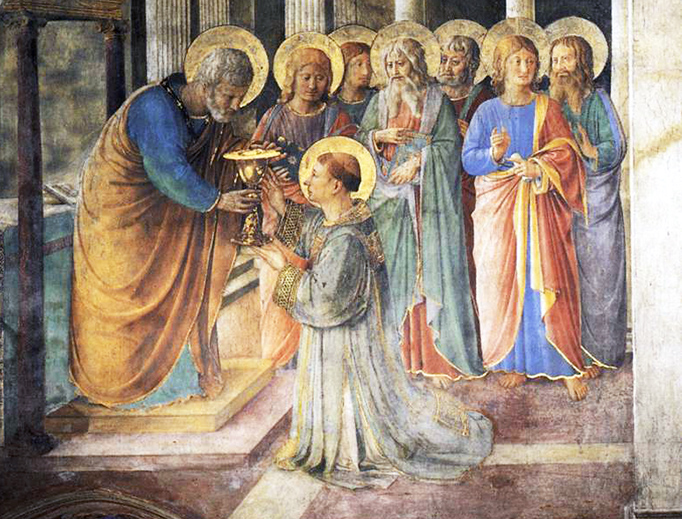
Even earlier than Irenaeus, in A.D. 80, Clement I wrote in his Letter to the Corinthians, “Through countryside and city [the apostles] preached, and they appointed their earliest converts, testing them by the Spirit, to be the bishops and deacons of future believers. Nor was this a novelty, for bishops and deacons had been written about a long time earlier. . . . Our apostles knew through our Lord Jesus Christ that there would be strife for the office of bishop. For this reason, therefore, having received perfect foreknowledge, they appointed those who have already been mentioned and afterwards added the further provision that, if they should die, other approved men should succeed to their ministry.”
Clement claims that as the apostles spread out and preached the Gospel, they carefully appointed bishops and deacons to hold a specific office of authority. The apostles then “added the further provision” that if these leaders should die, “other approved men would succeed to their ministry.” It sounded like the teaching authority of the early church was centered around this system of appointment: apostles appointed replacements, who appointed replacements, and so on.
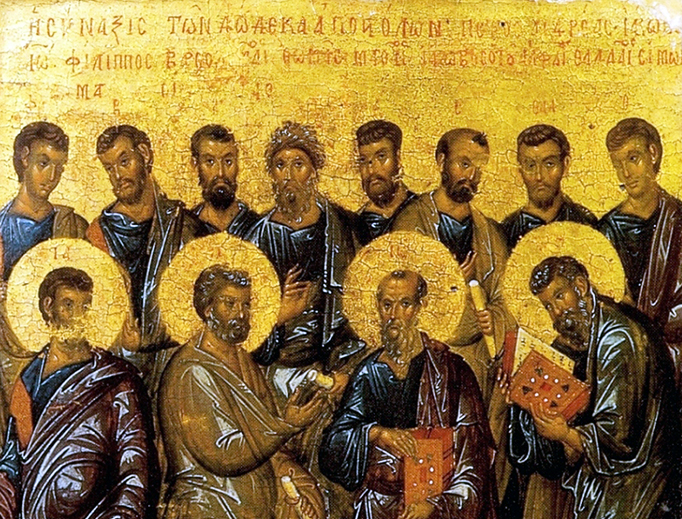
I looked for more examples, and found that Tertullian seemed to illustrate the same idea in 200 A.D. He writes in his Demur Against the Heretics, “From this then, we draw up our demurrer: If then the Lord Jesus Christ sent the Apostles to preach, no others ought to be received except those appointed by Christ. For no one knows the Father except the Son, and to him whom the Son gives a revelation. Nor does it seem that the Son has given revelation to any others than the Apostles, whom He sent forth to preach what He revealed to them.”
He continues, “But what they preached, that is, what Christ revealed to them – can be proved in no other way except through the same Churches which the Apostles founded, preaching in them themselves “viva voice” as they say, and afterwards by their Epistles. If these things are so then it follows that all doctrine that agrees with the apostolic Churches, those nurseries and original depositories of faith, must be regarded as truth…And indeed, every doctrine must be prejudged as false, if it smells of anything contrary to the truth of the Churches and of the Apostles of Christ and God…We communicate with the apostolic Churches because there is no diversity of doctrine: this is the witness of truth.”
According to Tertullian, true doctrine was determined based on whether it agreed with the apostolic Churches. If the issue claimed an idea contrary to them, it was false, because all churches must commune with the apostolic Churches to remain in the truth.
I paused, thinking hard.
This idea of “viva voice” was beautiful to me. I loved the idea of the “living voice” of the apostles, echoing their Savior’s words and reverberating out into the world as one – with “no diversity of doctrine” – helping the fledgling church understand how to interpret and apply the true faith when facing issues the Bible doesn’t clearly define.
Tertullian continued.
“[W]hat it was which Christ revealed to them [the apostles] can, as I must here likewise prescribe, properly be proved in no other way than by those very churches which the apostles founded in person, by declaring the gospel to them directly themselves . . . If then these things are so, it is in the same degree manifest that all doctrine which agrees with the apostolic churches—those molds and original sources of the faith must be reckoned for truth, as undoubtedly containing that which the churches received from the apostles, the apostles from Christ, [and] Christ from God. Whereas all doctrine must be prejudged as false which savors of contrariety to the truth of the churches and apostles of Christ and God. It remains, then, that we demonstrate whether this doctrine of ours, of which we have now given the rule, has its origin in the tradition of the apostles, and whether all other doctrines do not ipso facto proceed from falsehood (emphasis mine).”
Clearly, this apostolic thread was paramount in handing down the faith, in discerning true doctrine, and, as Tertullian continued once more, in defeating heresy.
Tertullian wrote, “if there be any [heresies] which are bold enough to plant [their origin] in the midst of the apostolic age, that they may thereby seem to have been handed down by the apostles, because they existed in the time of the apostles, we can say: Let them produce the original records of their churches; let them unfold the roll of their bishops, running down in due succession from the beginning in such a manner that [their first] bishop shall be able to show for his ordainer and predecessor some one of the apostles or of apostolic men—a man, moreover, who continued steadfast with the apostles. For this is the manner in which the apostolic churches transmit their registers: as the church of Smyrna, which records that Polycarp was placed therein by John; as also the church of Rome, which makes Clement to have been ordained in like manner by Peter.”
- Apostolic tradition
In light of my original question – how did the early church handle disagreements about the faith? – this was mind-blowing.
From the beginning of Christianity, it seemed, the faith was passed on and heresy was defeated not only by the “sole rule” of the Bible. After all, this was the problem in the first place: very often, those teaching false doctrine were using Scripture to support their false teachings. Who should be believed, if both the defender of truth and the false teacher claimed the same authority to support their contradicting doctrines, especially in matters on which the Bible did not define?
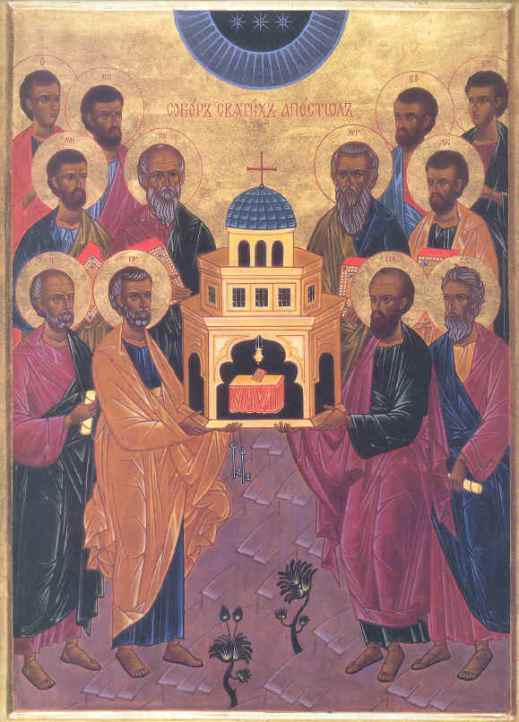
While defenders of the true faith did rely on the authority of Scripture, they also claimed another authority that enabled them to interpret the Scriptures faithfully. Those who defended the faith against heresy – defining what we as Christians do and do not believe from the earliest days of Christianity and onward – were successful because they could claim, along with the authority of Scripture, and by the guidance of the Holy Spirit, the ability to faithfully interpret and teach the faith. They could claim this because of their unbroken line of authority back to the apostles of Jesus.
I wasn’t sure what to make of all of this.
From the founding of Christianity, it would seem, this was the process for measuring opposing claims about the faith. Of course, claims to truth could not deviate from the anchor of Scripture. But when issues arose that required further definition, it seems they were evaluated by this concept of “apostolic tradition,” and preserved by a hierarchical church with successional bishops and deacons. Perhaps this apostolic tradition was the means by which the successors of the apostles authoritatively measured and passed-on the doctrines of the faith, defending it against ever-arising heresies.
“Okay, maybe this is how we know our faith.” I wondered aloud. “From the beginning there was Scripture, and apostolic authority to interpret it. There was a line of bishops who could trace their lineage back to the apostles of Jesus, and these men led the church through the ages and through every heresy. Followers of Jesus recognized and submitted to this authority.”
- Never, ever
Back at the kitchen table where I’d been mentally reviewing my research, I opened my eyes and stared unseeingly out the window.
I felt incredibly disoriented.
If the early church really believed that the Holy Spirit would protect these special, anointed, and appointed leaders from error and enable the faith to be spread far and wide, what did this mean for believers now?
Was this idea of apostolic succession the means by which Jesus intended for us to resolve disagreements, and remain one?
All of this information was quite surprising and ground-breaking for me, and I didn’t really know what to do with it.
I drummed the table once more, deliberating. The main reason I was even doing this research was because of the questions my best friend, Beatrice (still not her real name), had posed years ago as she struggled to know how to choose which church to attend. Her questions had recently surfaced in my mind as I wrestled with the claims my Protestant church made, in contradiction with other Protestant churches.
While I’d only been wrestling with these questions for a few weeks, Beatrice had spent the interim years researching her original question of “where should I go to church?” Through those years I’d repeatedly rejected any of her attempts to explain her findings. Why should I care about them, when I was perfectly happy at the church I attended? I had been certain that I had zero need to hear anything she might have to say.
Until now.
I pulled out my phone and called her, feeling an urgent desire to fill her in on my journey thus far.
“What do you make of all this?” I asked, when I finished.
“Well,” said Beatrice slowly, hesitatingly. There was a long pause.
“…yes?” I asked.
“Do you think your findings could point to Catholicism?”
Seconds of silence ticked by, and I couldn’t say a word. She and I had been raised Catholic. It had, in a nutshell, not gone well, and we had both left in middle school for an Evangelical church. If there was one thing I knew in life, it was that I was never going to be Catholic. Been there, done that.
The pit in my stomach, which had originated on the day I began this research project, seemed to double in size.
“Catholic,” I continued. “You cannot be serious.”
“I mean, all of these guys – Clement, Irenaus, Tertullian – were Catholic,” she replied. “If the early church was trustworthy enough to define and defend the faith, to give you the Bible – shouldn’t they be trustworthy on other matters, too? Don’t you want to know what else they believed and taught?”
She kept talking, but I was barely listening. While I appreciated all I’d been learning about the early church and apostolic tradition, I sure as heck wasn’t about to become Catholic.
“I just think you should have an open mind,” she concluded hurriedly, clearly sensing that I was ready to hang up. “Our individual experience shouldn’t define our understanding of an entire belief system. In fact, I am finding that there is actually so much more to Catholicism than we ever knew when we were growing up -”
“I will never be Catholic,” I interrupted her, firmly. “Let’s talk later.”
Completely shaken, I hung up and told my husband what Beatrice said.
“We need to stop her!” I lamented. “Why would she think these ideas definitely point to Catholicism? I mean, can you even be Catholic and have a relationship with Jesus?”
I was terrified for my dear friend. The idea of her considering Catholicism – let alone becoming Catholic – felt like the end of the world to me.
“This is absolutely terrible,” I concluded. “I need to do everything I can to prove her wrong.”
“I think you’re overreacting,” my husband said.
“I think I need to stop her!” I replied. “I’m pretty sure she even thinks Catholics have something that we don’t have.”
He laughed. “Like what?”
I thought hard, trying to remember what Beatrice began saying before I’d tuned her out in shock and anger.
Then I remembered.
“The Eucharist.”
Further reading
Apostolic Succession
Apostolic Tradition
Irenaeus, Against Heresies
Clement I, Letter to the Corinthians
Tertullian, Demur Against the Heretics
Successione Apostolica: Catholic Teaching on Apostolic Succession
Apostolic Tradition and the Relationship between Tradition and Sacred Scripture
By What Authority? An Evangelical Discovers Catholic Tradition
 All the Gifts
“ecclesial equivalent of Jason Bourne” …😂
Ok, so these are important…
Iranaeus…Against Heresies
Clement I…Letter to the Corinthians
Tertullian…Demur Against the Heretics
What other writings by early church fathers would you suggest?
Thank you.
LikeLike
Oh duh, I just saw your further reading list!
LikeLike