
- The Pillar and Foundation of Truth
There is an epic moment in one of the inarguably-greatest movies of all time – ‘The Sandlot’ – when Timmy Timmons walks away from another failed attempt to retrieve his friend’s baseball from “the beast’s” yard. Timmy shakes an enormous amount of dust out of his hair and makes a solemn pronouncement: “We’ve been going about this all wrong.”
This line from ‘The Sandlot’ seemed to summarize my angst one morning as I sat once again at my computer, morosely looking out the kitchen window at the brilliant summer day. I had been intending to read the early church fathers on the Eucharist as part of my effort to prevent my best friend, Beatrice, from becoming Catholic. But I couldn’t even start. A more fundamental, unresolved issue had been rising to the surface for weeks, and I couldn’t ignore it anymore. I stared out the window, trying to collect my thoughts.
Was I going about this all wrong?
Ever since reading the early church fathers on the importance of apostolic tradition, I felt like I was pinging back and forth between two very different paradigms for how to measure truth: Scripture and Tradition, or Scripture alone. I didn’t know where I should ultimately land. While my recent reading of the early church presented a very strong case for the importance of Scripture and Tradition, Sola Scriptura – Scripture alone – was the paradigm I’d been swimming in for over a decade. It was habit. When arguing with Beatrice about Catholicism, when asking questions, and when discussing any findings with my husband, I still measured truth by asking, “where is that in the Bible?”
But the church fathers didn’t appear to measure truth this way. They didn’t only ask, “where is that in the Bible?” Rather, they seemed to view it as a given that questions of faith were solved by discerning a faithful interpretation of Scripture, through the lens of apostolic tradition.
I got up from the kitchen table and walked over to the window, staring out at the trees swaying gently in the summer breeze.
Before I looked any further or asked any more major questions – such as whether the early church believed in the Real Presence of Jesus in Holy Communion – I needed to figure out which paradigm was correct, once and for all. The church fathers I read seemed to view both Scripture and Tradition as necessary for understanding the fullness of the Christian message.
If Tradition was as important as the church fathers made it sound, than the beliefs of the early church – that which was handed down from the apostles of Jesus to their successors – was essential.
So which was it? Scripture and Tradition, or Scripture alone?
I paused, turning from the window. I’d learned what the early church had to say about Tradition, but I had yet to really examine the Scriptural arguments for ‘Scripture alone’ or ‘Scripture and Tradition’ with these questions in mind.
Does the Bible teach that the Bible is our sole infallible rule of faith, or does it also teach the importance of Tradition – that which was handed down by word of mouth and by the writings of the apostles and their successors?
I decided to take a closer look.
- What you have heard from me
I sat back down at the kitchen table, ready to examine some of the passages commonly cited by Protestant and Catholic scholars to support their differing claims for Sola Scriptura or Scripture and Tradition.
Paul writes to Timothy that “all Scripture is God-breathed and is useful for teaching, rebuking, correcting and training in righteousness, so that the servant of God may be thoroughly equipped for every good work (2 Timothy 3:16-17). ” This word “useful” (ophelimos) can also be translated as “helpful” or “profitable.” While I’d heard this passage cited a thousand times to show that the Bible is our “sole infallible rule of faith,” I suddenly found it striking that it didn’t specifically say that. Saying that “all Scripture is God-breathed” is not the same thing as saying that Scripture is “sufficient.” Plus, ‘Scripture’ as we understand it wasn’t even a thing yet – isn’t Paul referring to the Old Testament here? I looked for more context.
Two verses earlier, Paul tells Timothy to “continue in what you have learned and have become convinced of, because you know those from whom you learned it, and how from infancy you have known the Holy Scriptures, which are able to make you wise for salvation through faith in Christ Jesus.” In Paul’s lead-up to detailing the power of Scripture in verses 16-17, he takes time to emphasize the importance of something else: reliable witnesses – “those from whom you learned it” – to correctly pass on the faith. The emphasis here is not only on what was received – but also who it was received from.
I read through the whole letter again. Earlier, Paul again references what he has taught Timothy by word of mouth. “What you heard from me, keep as the pattern of sound teaching, with faith and love in Christ Jesus. Guard the good deposit that was entrusted to you—guard it with the help of the Holy Spirit who lives in us (2 Timothy 1:13-14).” Paul is instructing Timothy to keep and guard that which he heard from Paul, which is “sound teaching.” Could there be a Scriptural argument for the importance of Tradition – the “good deposit” of sound teaching being passed on from the apostles to their successors?
Intrigued, I kept looking.
Paul tells the Thessalonians, “So then, brothers and sisters, stand firm and hold on to the traditions which you were taught, whether by word of mouth or by letter from us (2 Thessalonians 2:15, NASB).” Again, Paul seems to refer to the importance of the deposit of faith received from the apostles and handed on – by both word of mouth and in their writings.
What if one of the traditions we must hold on to is the belief in the Real Presence of Jesus in the Holy Eucharist?
I drummed my fingers on the kitchen table. The answers to these questions were enormously important. If the deposit of faith is contained in both Scripture and Tradition, then the testimony of the early church would be enormously important.
I read one more passage.
Paul says “the pillar and foundation of truth is the church (1 Timothy 3:15, emphasis mine).” If Paul believed that we only needed Scripture to know our faith and be saved, then why would he describe truth as fundamentally reliant on the “pillar and foundation” of the church?
If the Bible teaches the importance of Tradition, and – as I’d already read – the early church did as well, then why would I insist on using the paradigm of Sola Scriptura to guide my understanding of the Christian faith? Wouldn’t that be unbiblical?
- By word or by letter
For so long I’d presupposed that Scripture was utterly sufficient without an interpreter, and thus all doctrines and definitions and dogmas were limited to it. I’d assumed that anything else had been added-on over time, confusing the faithful. If this was the case, then the church needed to be regulated and “brought back” to Scripture.
On the other hand, if Sola Scriptura isn’t in the Bible, then isn’t Sola Scriptura self-refuting? The concept of ‘Scripture and Tradition’ certainly seemed Scriptural, as I laid out the verses from both sides of the debate. At one point Paul explicitly praises the use of Tradition as good thing, writing, “I praise you because you remember me in everything and hold firmly to the traditions, just as I handed them down to you (1 Corinthians 11:2).”
If Paul talks about “holding fast” to the teachings passed on “by word of mouth or by letter” and claims that “the foundation of truth is the church,” then who was I to say that the traditions which shaped the early church were not essential for knowing our faith?
What did these first Christians – who walked with Jesus, founded the Christian church, and ordained successors to protect and pass on the faith – believe and teach by “word of mouth?” What did the apostles receive from Jesus and pass on to their successors?
What did they say about the Presence of Jesus in the Eucharist?
Unlike Timmy Timmons and the ‘Sandlot’ crew, I didn’t need total surprise or an airborne attack – although that sounded awesome. I was beginning to believe I needed a paradigm shift for how I measured truth.
- Betrayed Again
It felt like the ground was beginning to collapse under my feet. I decided to run my thoughts by my younger brother, who was as gung-ho as I was about preventing Beatrice from becoming Catholic. Over the prior months, he and I had essentially formed an alliance in arguing with Beatrice about Catholicism, and I knew he’d been researching non-stop. Perhaps he could reconcile this idea of Tradition and Scripture, and show me how it worked without doing something insane like having a Pope.
“Right,” Brendan said, after listening quietly while I explained some of my thoughts. “I’ve actually decided that I’m going to become Catholic.”
My mind seemed to go blank. I sat rigidly in stunned silence.
This felt like a horrific-nightmare-version of deja-vu. When my dear friend Beatrice told me she was considering Catholicism, I had felt completely blindsided. Now my brother, another one of my best friends in the world, wanted to become Catholic? I couldn’t believe it.
“We haven’t talked about this in, what, less than a month?” I exclaimed. “What the heck happened?”
“Well,” he replied, “a lot, actually. I was reading up on as much about Catholicism as I could, so I could argue better with Beatrice – but then everything became so intriguing, I couldn’t stop reading. I read the Catechism of the Catholic Church, a ton of the Church Fathers, and dozens of papal encyclicals.” He paused. “I’ll need to explain this later in way more detail, but, to summarize: Catholicism just makes sense. Of everything. I feel like every question I’ve ever had about Christianity were like pieces of a puzzle that I could never solve – until I discovered the Church that put the puzzle together in the first place; the Church that has been there from the beginning. It all fits. I’m totally convinced. So, I’m becoming Catholic.”
I was floored. And angry.
“But I thought we were going to convince Beatrice not to become Catholic!” I exclaimed. “Now you’re literally going to beat her to it?” My trusted ally was truly blindsiding me, going rogue and decamping for enemy territory.
“Honestly,” he said, “I just had no idea what the Catholic Church actually believed or taught about anything. Now that I’ve learned what it teaches, and why they make the claims they make…” He paused again. “I’m in,” he continued, sounding very solemn. “Completely.”
My head was pounding. I didn’t know how Caesar felt when he was stabbed by Brutus, but I was pretty sure I could make a good guess.
“Hey I have to run to class,” my brother said, breaking the silence. “Where are you in all of this?”
“I don’t know,” I said, feeling utterly defeated. My brain was swirling. “I was going to learn more about what the early church believed about communion – whether they think it’s the “Real Presence” of Jesus or not.”
“Yes,” he said, “that’s huge. Let me know what you find about that, and let’s talk soon. Also, I love you.”
“I love you too, traitor,” I said, only half kidding, and we hung up.
- No fear in love

I turned back to my computer. I didn’t even get a chance to fully explain my shifting paradigm, although now I felt afraid to do so.
In fact, this new revelation from my brother terrified me.
I looked out the window some more, wondering where this fear came from.
I’d written off Catholicism the day I sprinted away from the last mandatory school Mass of eighth grade. I hadn’t encountered the Gospel in a personal way until my family began going to an Evangelical church down the road, and my resentment toward Catholicism – and my allegiance to Evangelicalism – had been very strong ever since.
But now my questions seemed to come in waves.
If Jesus is truly the Way, the Truth, and the Life, then why should I be afraid of where He may take me?
What if my personal experience of Catholicism was an unfortunately-poor example, but not representative of Catholicism itself?
If Jesus really founded a Church, and that church is the Catholic Church, then why should that terrify me? If He didn’t, then nothing needed to change. Certainly I could win Beatrice and my brother back, if the truth was on my side.
All that mattered was that I followed Jesus, wherever He led. That’s all I wanted. That’s all Ryan, my husband, wanted as well. So, if there indeed is no fear in love (1 John 4:18), then it was time to let the perfect love of God cast out all my fear.
I needed to dive in, come what may. Before learning about the early church and the Eucharist, I would change my mentality. Instead of seeking to learn about Catholicism in order to try and prove other people wrong, I would simply seek the truth – whatever that looked like. “All truth is God’s truth,” as my husband continually reminded me. I knew I could trust Jesus – Truth Himself – completely.
If I was changing my mentality, I could see that it was also time to change my approach to learning about what the Catholic Church taught. To date, my method was rather imprecise – to put it generously. If I believed the Catholic Church was wrong about some topic, I’d bring it to the attention of Beatrice. I would explain my reasoning, and make the case that she therefore shouldn’t become Catholic. Beatrice would then spend many minutes explaining to me the enormous chasm between what I thought the Catholic Church believed and what it actually taught. All of this would be brand new information for me. This would generally render me speechless, leave me with no rebuttal, and I’d usually end up saying something like, “I’ll look that up myself.” Then I would switch the subject, and the whole charade would repeat itself. This was a huge waste of time, and I knew if I could master what Catholicism actually taught, then I could go about tearing it apart and stop Beatrice and Brendan from making a huge mistake. Ideally.
Now if only I knew a kind, local Catholic who could help me get started.
- Enemy territory
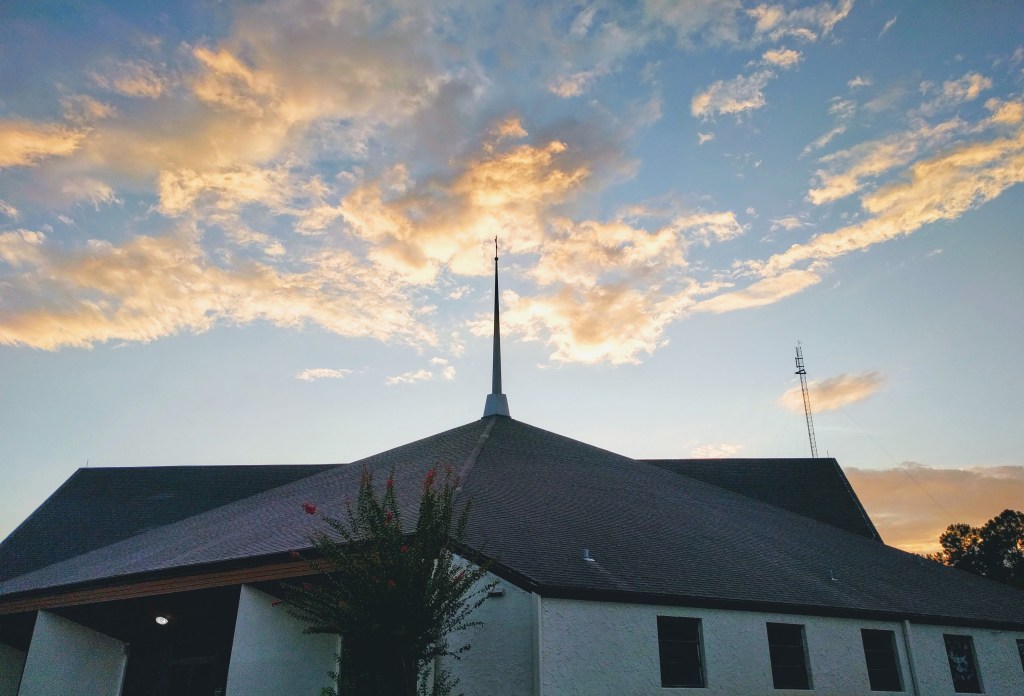
“Here,” said Amanda. She was holding out a squat paperback book. It’s bright blue and red cover glinted as the Florida sunshine streamed in through the windows of the church hall. I shifted uncomfortably, looking around the room as if a sign blaring “PROTESTANT CURRENTLY ACCEPTING CATHOLIC CATECHISM” would suddenly appear on the beige walls.
Amanda had been my husband’s close friend since high school – and forever labeled “Amanda Catholic” in his phone. She had immediately become one of my favorite people when I first moved to Florida. She and Ryan and I always had great conversations about Jesus, and she was always interested in and supportive of Ryan’s work as the youth pastor of our Protestant church. I wanted to pick her brain about Catholicism, and she had invited me to get coffee and chat. She had also invited me to first join her at daily Mass, which I had firmly declined. We compromised by agreeing that I’d pick her up at the church after Mass was over. Somehow we ended up chatting in the parish hall, where she was now handing me the enemy’s playbook – also known as the Catechism of the Catholic Church.
“Are you sure you can just give this to me?” I asked, looking around the room at the many bookshelves, all filled with materials that were clearly being used for teaching.
“I don’t think anyone would mind,” Amanda said, laughing, and still holding out the book. “I’m sure they’d love for you to read it.”
I was stalling, and I knew she could sense it.
“I’m mainly impressed that you guys even have Bibles on the shelves,” I joked. “Is that just for decoration?” She laughed again, knowing I was only kind of kidding, but she also didn’t stop holding out the Catechism. I sighed. I knew I should learn what the Catholic Church taught, but in all honesty, I just didn’t want to.
Figuring the book wouldn’t, probably, burn my hand if I accepted it, I took it and examined the cover. “A sure norm for teaching the faith,” proclaimed John Paul II, whom I vaguely remembered as being Pope when I was in Catholic grade school, and whose death I’d barely noted as a junior in high school.
I flipped it over. Not seeing anything like “how to worship Mary in three easy steps,” or, “tithing and the forgiveness of sins, a simple Venn diagram,” I figured I should give it a read. After all, getting owned whenever I tried to debate the supposed shortcomings of the Catholic Church was getting tiresome, especially as I didn’t even know what Catholicism claimed, let alone why.
I reluctantly accepted the “sure norm for teaching the faith” and headed for the door, eager to leave the church grounds. I felt unnerved and uncomfortable, walking around a Catholic church’s campus and carrying a Catechism. I tried not to out-pace Amanda in our walk across the endless parking lot. What if I ran into someone my husband or I knew? How would I explain myself? “Just carrying around some extra kindling for a mid-day summer bonfire, nothing to see here,” was the best I could come up with as we finally arrived at my car. I hurriedly opened the door to the backseat. As Amanda climbed into the front of the car, I quickly covered up the Catechism with other books from the back seat, and threw a cardigan on top of the pile for good measure.
I was ready to let the Catholic Church speak for itself, but certainly no one else needed to know about it.
I slid into the front seat of my car and sped us away from the Catholic grounds, mentally reviewing the next steps of my ‘Learn What Catholicism Actually Teaches So I Can Destroy It And Stop Beatrice and Brendan From Becoming Catholic’ game plan:
First, find out what the Catholic Church claims about the Eucharist, and why. Then, learn what the early church taught about the Eucharist through the first centuries of Christianity.
The unnerving possibility that those two topics could be connected had not yet crossed my mind.
 All the Gifts
“I was beginning to believe I needed a paradigm shift for how I measured truth. ” Yes! Once I realized that I had no standard for Truth, my whole mindset changed! I also love the weaving in of The Sandlot!
LikeLike