
Ryan, my husband, was slightly annoyed. We were standing in the kitchen as I was excitedly sharing what I’d been learning about the early church, the Catholic Church, and the Eucharist. Was it possible that the Catholic teaching of the Real Presence of Jesus in the Eucharist was what Christians had always believed, since the founding of the Church? Ryan was confused.
“I just need to know your thoughts,” I said. “The early church and the Catholic Church sound super similar about this, and I don’t know what to make of it.”
He thought for a moment.
“Well,” he began, “I agree that these early church writings are interesting. In fact, I remember sitting in church history class in seminary one day, when something really struck me.” Ryan had graduated from one of the top Evangelical Divinity schools in the country, and was currently working as a youth pastor at our Non-Denominational church.
“What struck you?” I asked.
“That all these people we were learning about in class were Catholic.”
I nodded, looking at him.
“Did that bother you at all?” I asked.
“Nope,” he replied. “It’s an interesting historical fact, but it’s not like that meant I needed to become Catholic or anything.”
“Why not?” I asked.
“Because I just have so many issues with the Catholic faith.”
To my great surprise, his answer suddenly triggered a wave of disappointment in my heart. “What on earth?” I wondered to myself, shocked at my own reaction. “I am the one who bolted away from the Catholic Church at age thirteen, and vowed to never look back. Do I want Ryan to want to become Catholic? Am I insane?”
The more I thought about it, the more obvious it became: learning what the early church – and the Catholic Church today – believed about the Eucharist made me want to receive it, immediately. After more than a year of debating with my brother Brendan and my best friend Beatrice about Catholicism, it was clear that a chink in my anti-Catholic armor had finally been made – and it was unbelievably disorienting.
But, Ryan was right. There was a lot more to consider.
“There’s the Catholic teaching on Mary,” Ryan went on, breaking through my thoughts, “which I find to be totally odd. There’s the role of the Papacy, which I disagree with completely. Plus it seems like the Catholic Church has just made stuff up over time – adding doctrine and dogmatically deciding things that don’t line up with Scripture.”
I sat in silence, thinking over what he said. Again, I felt a strange resistance to his comments. While I would have been in total agreement with his statement even a few days prior, I suddenly realized that I was now less confident. Ryan and I had never heard a robust, Catholic explanation for these Catholic teachings before. Reading the Catechism of the Catholic Church and the Church Fathers on the Eucharist had been startlingly eye-opening for me, totally shaking the ground beneath my feet.
What if there were compelling arguments for these other topics – arguments we just hadn’t encountered yet?
Ryan eyed me, clearly sensing something was off.
“Hold on, do you want to be Catholic?” He asked in surprise, looking at me questioningly.
I thought for a moment, feeling the weight of the question and pondering how to voice the confusion I felt.
“No,” I finally answered, surprising myself with my hesitancy. Mere days earlier I would have responded with an immediate, definite, “absolutely not.”
“It’s just that I find the teaching on the Real Presence in the Eucharist to be so compelling,” I went on. “Reading these ancient texts, and seeing how the early Christians spoke of the Body and Blood of Jesus – it’s so powerful, it’s completely Scriptural, and the entire Church believed in the Real Presence of Jesus in the Eucharist for more than fifteen hundred years.” I hesitated. “And,” I added, “if it’s true, I want to receive it. Badly.”
“I understand what you’re saying about the importance of the Eucharist,” Ryan replied. “However, I don’t think the Catholic Church is right about so many other things that are also extremely important. Why would I put any confidence in the Catholic Church’s teaching on the Eucharist, when they seem to be wrong about so much else?”
I nodded, deliberating his point. “There is still so much I don’t understand either,” I said. “I don’t understand the Papacy, or the role of priests. I don’t know enough about church history, but if you are saying that doctrine was just added over time, then that’s definitely something to look into.” My voice trailed off as I thought back to my many years of growing up in the Catholic Church. Had I learned anything?
“Not to mention that Catholics think we are saved by faith and works,” Ryan continued. “I mean, there are just so many differences between Catholics and Protestants, on so many levels.”
Ryan walked around the counter and hugged me. “There is so much more to look into before I would even consider the idea of Catholicism,” he went on. “If you want to keep looking into it and updating me on what you find, that’s great.” He looked at the clock. “But I’m so busy with ministry and coaching that I don’t have the time – or, honestly, the interest – to read up on this now. We can keep having conversations with Beatrice and Brendan, and we can keep talking about it however much you’d like.” He paused, eyeing me once more and clearly sensing my unease.
“Don’t worry,” he said, looking into my eyes. “We will seek Jesus, and we will follow Him wherever He leads us.”
I looked back at him. “Even if one day we find that Catholicism is true?” I asked.
The question seemed to fill the room. It was a huge one. My husband had spent seven years studying the Bible and theology, preparing for a lifetime of service to the church as a Protestant pastor. We loved our church family. Ryan loved his job as a youth minister. I knew how huge this question was for him, for us, and for our future. I badly wanted to know what he would say.
He didn’t hesitate. “If Catholicism is true, if that’s really the Church that Jesus established, then of course we’d become Catholic.”
“But,” he went on, rubbing my back and then beginning to leave the room, “it isn’t true.”
His voice filtered down the hall as he headed back for his work desk.
“At least,” he called back to me, “as far as I can tell.”
- An Invitation

“I mean, there are a lot of interpretations of John 6,” Ryan was saying as he drove our car down the road. “Just because Catholics have held a certain view for a long time, doesn’t mean it’s true.”
Over the ensuing weeks since our conversation in the kitchen about my findings on the Eucharist, Ryan and I had continued to discuss the topic off and on. Every time I brought up what I thought was an interesting argument, Ryan always seemed to have a rebuttal. Whether citing Protestant scholars or the original Greek of Scripture, his responses always sent me back for more in-depth research. While I kept finding what I believed to be compelling answers to his questions, it gradually became a moot point – Ryan’s questions were endless.
Eventually, we just dropped the topic.
However, Catholicism had come up once again as we were, strangely enough, on our way to St. Dominic Catholic Church.
Our friend Amanda had called and invited us to the new young adults group that met at St. Dominic. For Ryan and I, who had spent many months doing non-stop ministry in our own church, the allure of joining – and not leading – a Bible study was too good to pass up.
Amanda had mentioned that some of Ryan’s local friends from his high school days would also be attending, and that the church had gotten a new priest whom she thought we’d really like.
“I just can’t get over the fact that we are driving to a Catholic Church for a Bible study,” I said uneasily, knowing I was feeling way more uncomfortable than Ryan.
Ryan laughed. “I’m sure it’ll be great,” he said.
We pulled into the parking lot. It was getting dark, and we looked around at the many buildings in sight.
“Where do we go?” Ryan wondered.
We sat in the car for a few minutes, until we finally saw someone else pull up and head into the farthest building to the right.
“Should we follow them?” I asked. We got out of the car and headed toward the building. We both paused outside the front door.
“Do we just go in?” Ryan asked.
It felt strange enough to be at a Catholic Church, let alone barging into buildings and wandering around like we owned the place.
“I guess?” I replied.
We walked into what was clearly an office building. We saw lights illuminating the hallway beyond the foyer, and heard the sound of voices around the corner. We followed the sound, and suddenly found ourselves in a small, brightly-lit room with a large rectangular table in it’s center. Ten or so people were crammed around the table, papers and Bibles strewn over its surface.
“Hello!” Amanda called out from the far end of the table. She jumped up and dragged more chairs to the table. “I’m so glad you could make it!” She exclaimed, happily. She made room for us, and we sat down next to her and took out our Bibles.
Our first Bible study surrounded by a bunch of Catholics was – surprisingly – awesome. We discussed the concepts of spiritual desolation and consolation, as taught by St. Ignatius of Loyola. We prayed with different Bible passages and discussed them together. All seemed fairly normal.
But then, something odd happened.
- In the adoration chapel
“We’re going to head over to the adoration chapel and take all of this to prayer,” Fr. Michael, the priest, announced.
Everyone got up and began to head for the door.
“The ador… what?” I whispered to Ryan.
He shrugged, so we grabbed our Bibles and followed the other young adults across the parking lot.
We were the last to enter the side door of the church sanctuary, and saw that everyone had already filed into a tiny chapel immediately on the left.
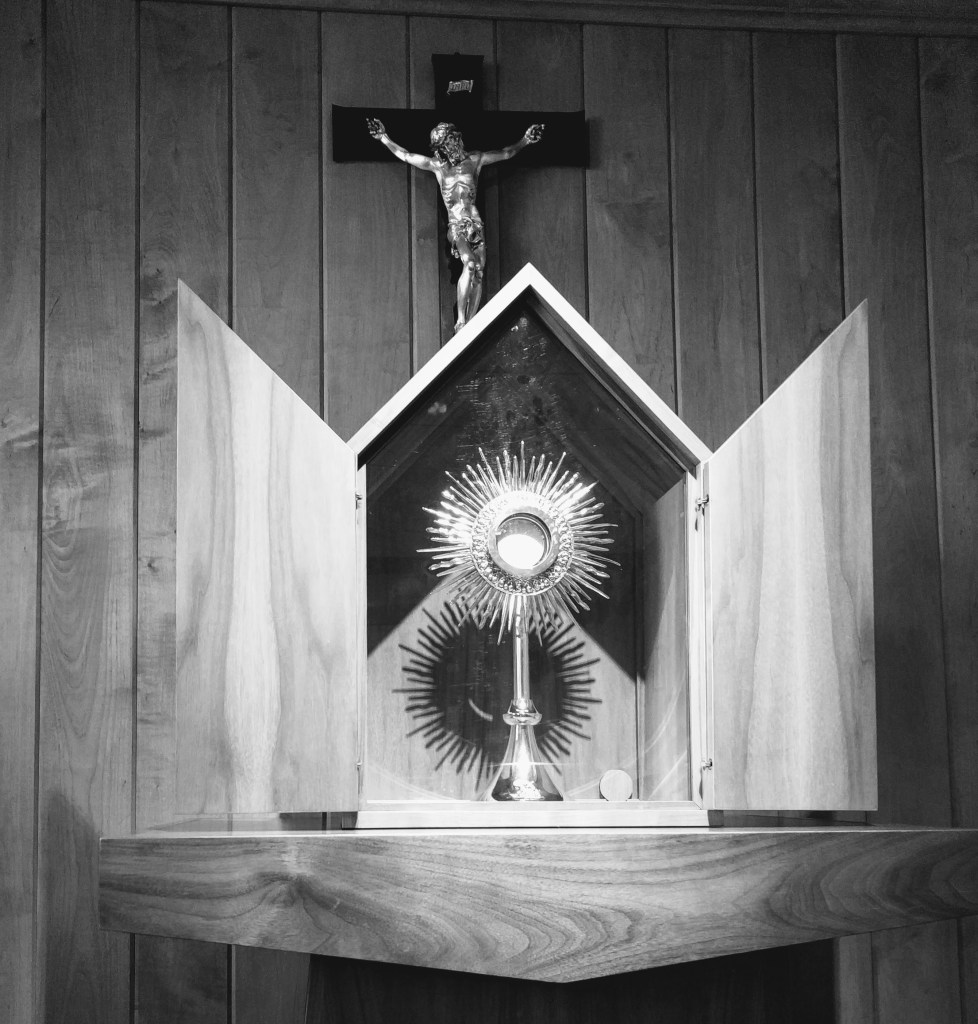
We entered the room and saw the priest and the young adults kneeling on the carpet. At the far end of the room, a golden stand was placed on top of a tall wooden podium. In the center of the golden stand was a white circle, indented with a cross.
I stood in the back of the chapel, taking in the silence and obvious devotion of those praying. They were all gazing at the white circle. Suddenly, I realized why they were looking at it.
It was the Eucharist.
I froze.
All I’d read about the Eucharist leapt into my mind.
If it was true, if Catholics were right, then Jesus – Jesus Himself – was truly present in the chapel, right now. I stared at the Eucharist, feeling dizzy.
Ryan tapped my arm, breaking my reverie, and gestured to a bench in the back corner of the chapel. We crept over to it and sat down, trying not to make a sound.
“Do we kneel?” I silently mouthed to Ryan.
He quickly shook his head. He got out his Bible and began to read. I opened my Bible as well, but I couldn’t stop myself from staring up at the Eucharist once more.
The whole scene was so foreign, yet so beautiful to me. As I gazed at the bright white host, I thought back on that night’s Bible study. The priest had spoken with such obvious love and passion about following Jesus, and the young adults were clearly on fire for their faith. Their sincerity and joy were infectious, and I was taken completely off-guard.
It was as if the bright light streaming onto the Eucharist was also piercing my own heart, revealing the fog of countless stereotypes I’d held about Catholics over the past decade.
There are Catholics who love and study and read the Bible, who are passionate disciples of Jesus, and who care deeply about their personal relationships with Christ?
There are priests who are zealous, knowledgeable, and loving shepherds, who desire to lay down their whole life for Jesus and the Church?
I had no idea such people existed.
I’d spent the prior twelve years of my life feeling angry with Catholicism. I had loathed the idea of priests, disliking what I viewed to be an unnecessary role that made it difficult for lay people to take responsibility for their own faith. Priests seemed to represent, in my mind, a barrier between God and man.
My interactions with priests from the parish and school of my childhood were limited to the scoldings I’d received as an altar server. My poorly-developed, experience-driven opinion of priests was that they were crabby old men who begrudgingly attempted to harangue their congregations into being nicer people.
But meeting these people today suddenly revealed how unsubstantial my stereotypes had been. I still didn’t understand the purpose of the priesthood, but disliking the role of priests in general because of the two I’d met as a child began to reveal its own absurdity.
A question began to form in my mind, as I pondered the Eucharist and the people praying before it.
What if the conclusions I’d drawn about Catholicism – that it’s a ritual-based, vapid, robotic faith in which a living and personal relationship with Jesus is unattainable – was pure fiction, and the mere consequence of my unideal experience as a child?
What if, as Beatrice continually told me, concluding that all of Catholicism was false because of a few poor childhood witnesses was as silly as concluding that all math was false because of a few poor childhood math teachers?
I thought of the people I knew who had rejected Jesus because of the hypocrisy of a few Christians. Their decision was based on a personal experience – it had nothing to do with the actual claims of Christianity – and that experience-driven mentality had always bothered me. But in that moment I knew, beyond a shadow of a doubt, that I had been doing the same thing.
There I was, sitting in the last place on Earth I ever thought I’d be, thinking the last thoughts I ever thought I’d think – that Catholicism doesn’t suck.
It was terrifying.
Gazing at the Eucharist, surrounded by all these loving and faithful people who knew and cherished their Catholic faith, I realized I had spent years invalidating Catholicism based on my own isolated experience of it.
Without ever truly understanding what I was rejecting, I’d written off Catholicism and priests and the Mass and the entire faith system, certain that I was justified in my anger over my experience.
But meeting these Catholics tonight had blown my prejudices to pieces. Clearly, one can be Catholic and have a thriving and beautiful relationship with Jesus. This is what Beatrice and Brendan had been trying to tell me, for months, over our countless arguments about the Catholic faith. Maybe it was time to stop insisting they were wrong.
- The road ahead
“Well that was weird, huh?” I asked my husband as we pulled out of the parking lot.
He laughed. “What was weird?”
I frowned, trying to think of a way to express the new thoughts still spinning in my mind.
“I guess it’s weird that it wasn’t weird,” I said. I thought again of the stereotypes that had been blasted into smithereens that night.
“I think I’d always associated Catholicism with somehow lacking something,” I went on, rubbing my forehead as I tried to make sense of the evening. “As in, if anyone became Catholic, there would necessarily be an accompanying loss – in one’s personal prayer life, in relationship with Jesus, or in living out the faith in a strong community.” I shook my head, seeing Ryan about to interject. “I know, that is super stereotypical,” I continued, “but that’s how I’ve viewed it ever since my family left the Catholic Church twelve years ago.”
I looked out the window, watching hazy clouds drift past the moon.
“I’ve spent so long telling Beatrice and Brendan that becoming Catholic would hurt their relationship with Jesus,” I said. “That they would be giving up so much if they took this step. But what if someone can keep everything they love – intimacy with Christ, swimming in the beauty and truth of Scripture, following Jesus in community – and gain even more?”
I closed my eyes, picturing the Eucharist on it’s golden stand, elevated over the heads of the dozen praying people.
Ryan had been listening quietly, letting me get everything off my chest.
“I hear what you’re saying,” he said finally, squeezing my hand. “I really enjoyed tonight. It was great to talk about Scripture and spend time in prayer. It was fun seeing old friends, and I loved meeting Fr. Micheal.” He paused, looking over at me.
“But I didn’t have the same experience with Catholicism as you did, growing up,” he went on. “My family left the Catholic Church before I can even remember what it was like. While I get what you mean about tonight shining light on common stereotypes of Catholics, I guess eliminating those stereotypes just doesn’t carry the same weight for me as it clearly does for you.”
He squeezed my hand again, looking at me questioningly.
“Do you know what I mean?” He asked. “All my hang-ups are still there.” He let go of my hand and began reciting his list, ticking his fingers into the air with each one.
“The papacy,” he listed. “Adding doctrine over time, justification by faith and works, the emphasis on Mary and the saints.” He dropped his hand.
“If you want to look into all of this, feel free. But I don’t think I’ll be convinced.”
I nodded. Our experience at St. Dominic that night had lit a fire in my belly, but the answers to our questions also seemed about as far away as the moon – covered once more by haze and cloud.
I understood in that moment that this journey would be a long one. While I have always been quick to move and make a decision the moment I am convinced, Ryan has always been much more thorough and analytical. Not to mention, he had spent the last decade studying the Protestant viewpoint on every possible topic. The questions we were asking were huge, and I knew their answers would define the rest of our lives.
I set my face toward the road ahead and took Ryan’s hand, his list of issues with Catholicism echoing through my mind once more.
Tonight, I had seen that Catholicism could be good. Now I wanted to know more than ever if it was true.
 All the Gifts
Margaret, thank you for sharing your journey. I am intrigued by the path through which the Lord has led you and look forward to further posts. Blessings, Dawn Pantera (Jessica Welch’s Mom)
LikeLiked by 1 person
I love this! This has been my most recent experience with our first time attending Mass a few weeks ago and learning about Adoration (with your help!). Reading your experience is so relatable!
LikeLike