
- The Hall
Months had gone by, and a lot had changed. My brother had become Catholic, effectively beating Beatrice into the Church we’d set out to prevent her from joining. Beatrice became Catholic next. While my passion to learn more about Catholicism was still burning, it had decreased from a bonfire to a smolder. My original impetus – keeping Beatrice and Brendan from becoming Catholic – had become a moot point. My laser-focused research had begun to dissipate into the fog of my husband’s never-ending questions, and I began to settle into a permanent haze of uncertainty. A journey is only fun if a person intends on actually arriving – and I had no idea where I was going.
But my brother had a knack for launching hand grenades into my ecclesial lethargy – and today would be no different.
On this particular day, Brendan and I were talking on the phone while he walked around his Army base in Oklahoma and I walked my neighborhood in Florida, both of us enjoying the gorgeous fall weather. We’d been discussing one of our favorite authors – C.S. Lewis – and I decided to get my brother’s take on something that had been bothering me for a long time.
“I guess I would say I’ve spent the last several years describing myself as a “Lewis” Christian,” I was saying to my brother. “After I graduated from college, moved to D.C., and gave my life to Christ, reading C.S. Lewis completely changed me. His writings helped conform my heart and mind to Jesus. He helped re-introduce me to the truth and beauty of the Gospel.” I paused, thinking with gratitude of all Lewis had taught me. It was incalculable.
But while my love for Lewis continued unabated, there was a problem.
“You know in “Mere Christianity,” when Lewis describes the central components of Christianity as the“hall,” into which he is trying to bring people?” I began.
“Yep,” Brendan replied. “Lewis says ‘mere’ – or basic – Christianity is the hall, and one’s denomination is which ‘door’ you choose that leads off that hall.”
“Right,” I said. “Lewis says that Christians are united in that they are all in the same ‘house,’ but they disagree on doctrine and therefore prefer to live out their faith in different rooms.” I paused. “I used to love that analogy.”
“Used to?” Brendan sounded surprised. “Why don’t you like it anymore?”
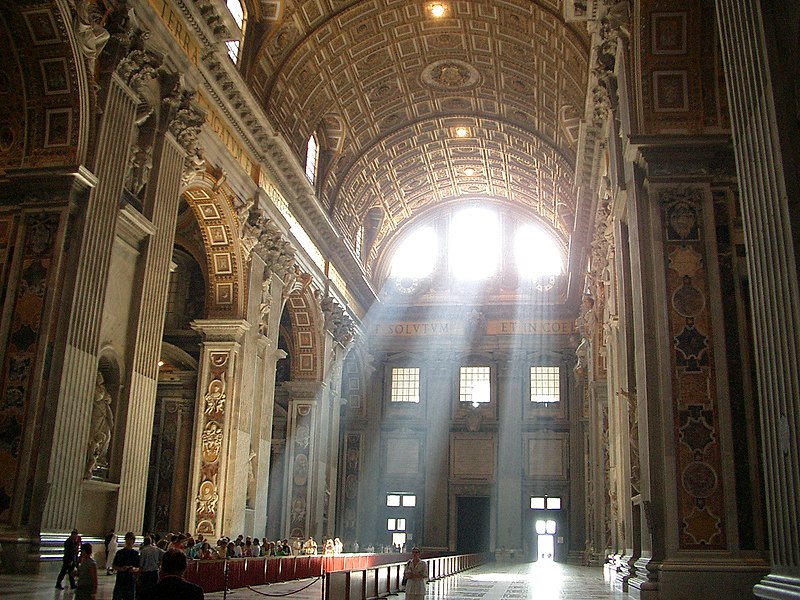
“Because the reality it illustrates is… devastating,” I said. “The ‘hall’ Lewis refers to is about a hundred miles long, and there are more than 35,000 separate doors to choose from. Who would ever call that “unity?””
I rubbed my forehead in frustration, picking up the pace of my walk.
“I know C.S. Lewis just wants to get people “into the house” of Christianity, so to speak, and he isn’t concerning himself with which church people choose,” I continued. “I understand – and still appreciate – his aim here, and I agree it is incredibly important in its own right.”
“But?” Brendan asked.
“But,” I continued, “I can’t find that “choose your own door” concept anywhere in the first sixteen hundred years of church history. Can you imagine if the apostles had gone out to make disciples of all nations, but then told every new bishop of every church that they could simply define dogma, and the canon, and the liturgy according to their own individual interpretations of the Bible?”
I paused, reflecting. For most of my life, I’d been part of a church that had separated itself from another church, because they thought their interpretation of the Bible was better. The church they broke away from had also originally broken away from another church, for the same reason. Where would that end? How could breaking away – refusing to worship and fellowship with other Christians – be a sign of a united body of Christ?
“What does Ryan think about all of this?” Brendan asked, breaking into my internal monologue.
“We don’t talk about it very much,” I said. “If we do, Ryan will raise a bunch of objections, and then I’ll try and find answers to them. Then we’ll discuss my findings, and then he’ll raise a million more objections.”
I shrugged to myself. I loved reading church history and theology, but Ryan had spent seven years learning the Protestant viewpoint on every possible topic. Even if I wanted to be Catholic, going toe-to-toe with my husband on every one of his million questions and objections was just not my idea of a fun time.
“I don’t know what the answer is,” I told my brother. “I don’t know whether Catholicism is true. I just feel increasingly discontent with the answers of Protestantism, and I feel compelled to keep searching. The Holy Spirit will lead Ryan, and Ryan will lead our family into the truth – whatever that is.”
“It’s Catholicism,” Brendan said.
I laughed. “I really don’t know about that.”
“Well,” he continued, “let’s go back to what you were saying about our hero, C.S. Lewis.”
- Home
Brendan paused for a moment.
“Here’s my bottom line,” Brendan began. “Over time, as I kept reading and searching, I became convinced that the only reason we even have the tenants of ‘mere’ Christianity, the only reason Lewis’s “hall” exists, is because, for over a thousand years, there was one, visible, hierarchical Church who had the authority to define what Christianity was in the first place.”
“Today, Protestant Christians hold so many of the big-picture doctrines of the early church – its creeds, its canon, its definition of the trinity, its definition of the two natures of Christ – all the major articles of our faith not explicitly defined in Scripture, which the early church gave to us. The more I read, the more I kept wondering: if this early church – who had the voices of the apostles “ringing in her ears” – was trustworthy enough to give us these important doctrines we hold today, why wouldn’t we also accept their teaching on other majorly important topics, such as the importance of Scripture and Tradition, or the role of apostolic succession, or the Real Presence of Jesus in the Eucharist?”
I pondered this question, my walk slowing to a crawl as he went on.
“I guess I just can’t fathom that Jesus came to earth to establish a “hallway,”” he went on. “I can’t believe that Jesus – who is Truth Himself – intended for all Christians to claim an objectively-true Gospel while ultimately disintegrating into ecclesial relativism. I just don’t think the plan was for each Christian to choose their own adventure and divide thousands and thousands of times – all while believing they each know the truth. There’s just no way that was the game plan.”
“As a Protestant,” Brendan continued, “I used to be convinced that the source of unity was simply sharing the essentials of the faith with other Christians. I assumed that this “invisible unity” was really the only option, and that as long as the main components of the faith were intact, some range of opinion – even on important topics – was unavoidable. But, as I kept reading and learning, it struck me that this mentality didn’t exist for the first 1500 years of the church.”
He paused.
“Yes, there were heresies during the early church and groups of people broke off. But there was always a living voice of authority who was able to define what was and was not heresy – who could define what it meant to be a Christian. My question now is this,” he continued, “how can we split from this original, authoritative body – the successors of the apostles who walked with Jesus – and still consider ourselves to be fully in the Church?”
I wasn’t sure what to say, and he was quiet for a few moments.
“The Catholic Church claims to be the house that Jesus built,” he said, finally. “It claims to have been there from the beginning. It claims to be the home of the family of God. Obviously, a son who is away from the family is still part of the family. But that doesn’t mean he is home.”
Something in this idea struck a chord in me. I could feel it reverberating in my heart.
“Catholics absolutely believe that Jesus intended for there to be one Church,” Brendan said. “Catholics believe that Jesus created a new covenant – a ‘new Israel’ – a new family of God. A family is never meant to be broken. The family of God is not meant to be scattered into thousands of different denominations; it is meant to be united in doctrine, sharing one meal, enjoying the headship of one Father, and building His kingdom together on earth.”
“Last thing,” Brendan said, “and then I’d love your thoughts on something. A huge part of my journey, after reading as much of church history, the church fathers, papal encyclicals, and the Catechism as I could, was uncovering this longing I had to be home. Back in the ‘house,’ so-to-speak, built by Christ. The family God created is so much bigger than I had understood before. It’s so much older. And it was created to be one.”
I was silent. I understood the longing he was talking about. I could feel it in my bones. Suddenly, the yearning in my heart was overwhelming, and I realized I was blinking back tears.
- Peter
We were both quiet for several moments.
“Regarding what you were saying about C.S. Lewis, I think it makes sense to be discontent with the reality of Lewis’s ‘hallway,'” Brendan said. “It represents a disunity we were never created to have.”
This made sense to me. I’d met plenty of people who celebrated the idea of having many churches to choose from, but I’d never met anyone who thought that churches splitting up and forming new denominations was intrinsically good – or something to aim for.
“Your questions keep coming back to the issue of authority,” he continued, slowly. “I would love to try and posit something that I think you may be missing right now.”
“Go for it,” I replied.
“Catholics claim that before Jesus ascended to the Father, Jesus gave us an earthly father to lead and unite the family of God. Like a good dad, this earthly father’s job is to defend and protect his family – the Church. He is to provide discipline and governance, and keep the family together.”
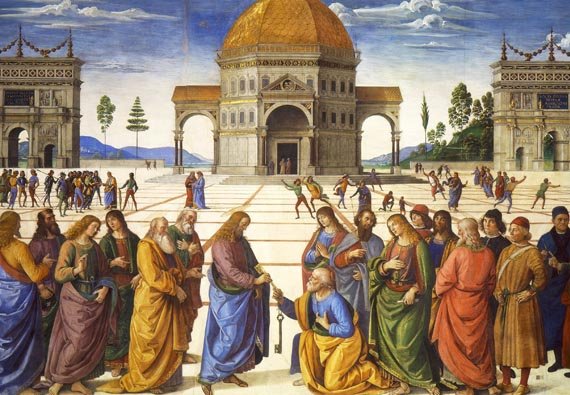
“This earthly father’s job is to feed Jesus’s sheep – to love and to shepherd them. His job is to be the servant of all the servants of God. He is to “bind and loose,” to keep and guard the keys to the Kingdom of God, and to ensure those keys are passed on to his successor until the day Jesus – the true King – returns to bring His family to our true home.”
Brendan paused again.
“What if the thing you’re still missing is the papacy? What if the answer to the questions you keep asking is Peter?”
There was a long moment of silence.
“Yikes,” I said, finally.
“What?”
“I’m on board with the idea of one, united family of God,” I said. “But the idea of the papacy just freaks me out. I don’t like it. I just don’t think I can get on board with some guy in Rome, telling everyone what to do.”
My brother laughed. “You’re such an American,” he said. “And I totally disagree with that line of thinking. The question to ask right now is not: ‘do I like the idea of a pope?’ Or, ‘do I think a pope is necessary?’ But rather, ‘did Jesus establish the papacy?’” Brendan said. “Would you be on board then?”
We were both quiet for another moment. I didn’t want to answer the question.
“Look,” Brendan continued, “if the Church began as a bunch of localized, independent, non-denominational churches, we would expect to hear some noise when Rome asserts its authority. But for a thousand years, there isn’t any noise at all. Wouldn’t it reasonable to expect there to be letters to Rome, from offended and indignant bishops from other cities, telling the Bishop of Rome to chill out and stop butting into their business? But, again – that isn’t a historical reality. Whether or not you currently think the papacy is valid, a hierarchical structure, centered on the bishop of Rome, is what happened. I think the burden of proof is on Protestants to demonstrate that the Catholic structure wasn’t Jesus’s intention.”
“Burden of proof?” I asked, surprised. “Isn’t that easy? There isn’t a pope in the Bible!”
“Catholics claim there is – that the Gospels and Epistles corroborate Peter’s unique leadership role, and that the entire early church unanimously believed that Peter was left in charge. I mean, I want to know how you would explain Matthew 16, when Jesus gives Peter the ‘keys to the kingdom?’ Do you claim that Peter wasn’t supposed to be the leader of the apostles? Or do you claim that Peter was indeed the leader, but then he just buried the keys Jesus gave him and didn’t pass them down to a successor? How would you explain Luke 22:24-32, or John 10:16, or John 21:1-17? Peter’s headship, unique role, and mission is all over Scripture – how does a Protestant make these fit the Protestant narrative, in a coherent way?”
“I don’t know, yet,” I said, feeling rather bowled over. “Look, I understand that the burden of proof is not only on Catholics. But since you’re the only Catholic in the vicinity, and since you brought it up, let’s talk about my many issues with the papacy.”
I paused, reviewing my mental list.
“Don’t Catholics believe that the Pope is ‘infallible’?” I began. “Why isn’t the word ‘pope’ ever mentioned in the Bible? Couldn’t someone argue that the papacy really did just evolve over time, as some kind of political power grab?”
“Great questions,” he replied. “First, I’ll explain what the Pope is – and more importantly, what he is not. Then we’ll talk about Scriptural and historical evidence. Then you’ll become Catholic.”
It was my turn to laugh out loud. “I’m down for all of it except the last part,” I replied.
I had just arrived at my front door. I let myself in, and headed straight to the kitchen table. I sat down, grabbed my laptop and notebook, and felt the thrill of the search once more.
“Go ahead and bring it.”
- Papa

“‘Pope’ means ‘papa,’ or ‘father,’” Brendan began. “The Pope is the bishop of Rome, the ‘icon of unity’ of the Church, and the vicar – or representative – of Christ on earth. He is the head pastor of the universal church, because we believe he is the successor of Peter. Catholics believe that Peter’s role as the leader of the Church was originated by Jesus, and continues on to each of Peter’s successors today. The pope’s job is to provide universal jurisdiction on all things related to faith and morals.”
“Uni…what?” I asked.
“Universal jurisdiction,” he replied. “Meaning he’s the supreme teacher, and it’s his job to preserve and propogate the faith for the universal church.”
I thought hard, going over everything my brother said.
“I’ll explain why the Catholic Church makes these claims in a minute,” he went on. “Let me define his role some more, first.”
“The Pope is not the king,” he continued, “Jesus is the King. The pope, instead, is the steward of the king. As everyone in Jesus’ day knew, it was the job of the steward to care for the kingdom while the king left or went off to war. In the absence of the king, the steward had the power to rule the kingdom. The power is not through his own right, but through his appointed role as the representative of the king. When a king appointed his steward, he gave him – literally – the keys to the kingdom.”
“An actual key?” I asked.
“Yep,” he replied. “A big heavy key that would open the big heavy doors at the gates of the kingdom. Only two people had this key: the king, and his steward. This is why – and we’ll get to this again later – Matthew 16 is such an important Scriptural basis for the primacy of Peter, for the visible church, and for Papal succession. Jesus gives Peter the keys to the kingdom of heaven. I wonder who Jesus wanted to be in charge when He ascended to the Father?”
- A gift
I ignored the question. “Okay, to summarize, Catholics believe that the pope is the ‘papa,’ the steward, and the representative on earth of Christ our King. But what about the whole “infallible” thing? How can a pope – a mere human being – be infallible, when they are sinners just like everyone else?”
“Sure, ” Brendan replied. “Papal infallibility is an idea that is usually grossly misunderstood by Protestants. At least, it was by me.”
“Essentially, papal infallibility is a grace given by God to protect the pope from leading the Church into error,” Brendan began. “Infallibility has nothing to do with the moral quality of the pope, and nothing to do with being sinless or omniscient.” He laughed. “The pope literally has no idea who will win March Madness this year,” he joked. “Although that would be awesome.”
“What a waste,” I said, grinning.
“So this part is super important,” he went on. “Papal infallibility is also not a claim to divine inspiration or divine revelation. We believe that Christ gave the full deposit of faith to His apostles, and it’s the job of the Church – the pope being the head of the Church and the successor of Peter – to guard that deposit and interpret it without error. Infallibility is the promise of protection from error in those very limited areas: when officially defining doctrine related to faith and morals.”
“In other words,” Brendan went on, “as I remember reading somewhere, papal infallibility is essentially a ‘negative charism.’ It is an unmerited gift from God – the promise of protection for God’s people – guaranteeing that the Church will never teach dogmatic heresy nor put it’s people in a position of having to choose between truth and unity. It is not a promise that members of the Church – or it’s pope – will be perfect, or even holy. The Pope may be a huge sinner, or he may say or do crazy things. But, through the promise of Jesus and the power of the Holy Spirit, the Pope cannot and will not teach error when he formally announces that he is defining the doctrine of the Church, as related to faith and morals. So, if a pope speaks off-the-cuff on an airplane, or even answers interview questions with some suspect ideas – this is not dogma that Christians are required to believe.”
“It sounds like you were ready for me to point out all the Popes who were major sinners throughout history,” I said.
Brendan laughed again. “Yep! I mean, we claim that Peter was the first pope, and he is on record for being a major wimp sometimes, and for putting his foot in his mouth all the time. But he never taught heresy. He was called out by Paul for behaving poorly and rejecting the Gentiles while he was around Jews. But Paul was simply – and rightly! – reminding Peter of the doctrine Peter taught: that God makes no difference between Jew and Gentile.”
“Okay,” I said, summarizing once more, “Catholics believe that the pope is the vicar of Christ, the supreme authority, who is given the grace of infallibility in those specific instances of defining faith and morals.”
“Yes,” Brendan said. “The claim is this: in a plan to protect the unity and integrity of the Christian family, Jesus bestowed the office of the papacy on the apostle Peter with certain graces that came with possessing the keys to the kingdom. Jesus gave the keys to Peter, and the Church has always taught that Peter’s role has been passed down through the ages to Peter’s successors. Remember,” he added, “the claim is that Jesus intentionally established this office, for the unity of the Church.”
“Got it,” I replied. “But can you prove it with evidence from Scripture?”
“Let’s do that next,” he said.
 All the Gifts
This was a huge hurdle we had to overcome. All the points you brought up changed my mind!
LikeLike